September 18, 2011

"San" but really Nioro

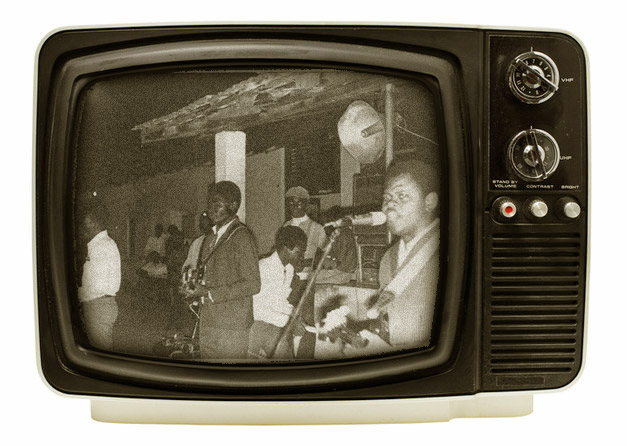
In this post I would like to share two wonderful videos from Mali. Both are by a 'troupe' from San, a town (or village?) in the Ségou region.

Ségou may be known as the historic heart of the Bambara empire, it is also a region with a large cultural variety and diversity. A diversity that has been eminently exploited by great stars like Hawa Dramé and Safoura Denou & Seny Sangaré.

In this case I have been told that the songs are both Sarakolé traditionals. The first song, "Danama", has also been interpreted by another Malian diva, the great Mah Damba, on her very first cassette. And I am sure I have heard the second song performed by another singer, somewhere, sometime (please help me out here...).

I love the almost informal 'ambience' and the sheer fun of these two songs, and more particularly the dancing. The men take turns in showing of their skills, almost in a peacock manner. And the women in turn react (when they feel like it) by joining them. And the dance itself has absolutely nothing to do with the over the top dancing that is sometimes presented as "the" African dancing.


Although I have had this video for over twenty years I keep discovering new details. I refer to the reactions by the participants of the troupe, and not to the curtain, - which has of course seen some great acts over the years (you may remember this video, and I´m sure you´ll find more examples on Ngoni´s great Youtube channel).

The second song starts of in a much slower tempo, which reminds me of Hawa Dramé. But then it gradually gathers speed until, after 4'20, it switches into another rhythm, and a more peacocky dancing ensues. What a delight!


EDIT/CORRECTION: January 15, 2012: A comment on YouTube, plus the find of a video by "Les artistes de San" have urged me to investigate the origin of the groupe in these two videos.
This research has led to the correction posted here.

The videos in this post are in fact from a groupe from Nioro, in the Kayes region and near the Mauretanian border. As to the cultural origins of the music it seems likely the comment on YouTube may be right that group is Bella (i.e. maure).

September 08, 2011

Mbaraka on TV

I have to confess it is at times hard to keep up with all the comments that are sent to me both on posts on this weblog and on videos uploaded to Youtube. Although I don't always have the time to react to all of these I can assure you I do read them and do appreciate all the comments* you send in.

The other day a comment was sent to me by a Mr. Msomali, who is - I deduce from his writings - a Tanzanian living in the UK. He wrote about a subject which is also very close to my heart and very high on my (unfortunately extensive) wishlist:
"I want to start the discussion of where the videos of Mbaraka Mwinshehe can be found. I am sure it is in Kenya and Japan.

I will explain why.
Mbaraka took his Morogoro Jazz Band as part of a large group of cultural ensembles/artists representing Tanzania in the EXPO 70 exhibition that took place in Japan in 1970. Being good in technology as they are, I am certain the Japanese recorded every event that went on in each pavilion.

As to Kenya: a lady asks her husband to take her to a Super Volcano show (when the Band was visiting the couple's town) as she says she listens to their songs almost every single day on the Radio, and she also watches them often on the Television. All this is in Mbaraka's song called 'Nipeleke Nikashudie' (which roughly translate as "Take me, so that I can see them perfom live"). By TV here she means VOK Tv (Voice of Kenya Tv).

I believe both VOK (now called KBC Tv) and NHK Tv (Japan's National Tv) have Mbaraka's videos in their archives.

I also believe that both these institutions have a public duty to release these videos of one of the truly gifted musicians to come out of East Africa.
His country was/still is too poor to have have had Television in his lifetime, but he served Kenyans and entertained them in equal measure, and has everyone listened to his song EXPO 70, celebrating his participation there?
Mbaraka belonged to all of us, so the least these two institutions can do to world music heritage is to release his videos into the public domain.

Any ideas on how we can go about asking them to do this service to world music, anyone?

Regards
Mr. Msomali
"

What can I say? I support this appeal wholeheartedly. I can't wait to see a video of this giant of Tanzanian music.

If there is anyone out there who has links with either Kenyan or Japanese television, please help us out!

And should you need any encouragement I advise you to listen to this brilliant sample of the great man's repertoire, which as it happens contains both the song "Nipeleke Nikashudie" and two songs dedicated to the EXPO in Japan (including that killer "Expo No.2"!!!!). And the five other songs are all equally disarming in their unpretentious and truely authentic brilliance.

POLP 566 (or POLP 566) (December 21, 2016: update the first link to 320 kbps)

* I would like to make an exception to those sad idiots (and I am holding back here...) who try and slip a commercial link into their so-called comments.

September 01, 2011

Crossover

Over the years I have come to acquire a distinct aversion against the term "crossover". It must have started in the eighties with (the highly respected and very likeable) journalist Stan Rijven, who was always on the lookout for the connection, the 'cross-fertilisation' (yuk) and the 'sameness of the other'. At the back of this inclination I couldn't help but suspect a lack of confidence in the appeal of African music.
My personal preference lay and lies in finding the 'otherness in the other', in the authenticity of the (so far) unknown. If I had wanted more of the same I wouldn't have ventured out into the realm of African music. How can I appreciate a crossover if I have no idea of the individual elements involved in the crossing?

Rochereau (r) with a very young Daouda Sangaré
Twenty-five years later my aversion is still present. Experience has shown that musicians claiming that their music is a 'crossover' between styles usually produce a watered-down blend of predominantly western music.

This doesn't mean, however, that all 'interaction' between different musical styles is uninteresting. But the real enjoyment of this can only start with the understanding and acknowledgement of the styles involved.

And that brings me to the subject of this post.

For how can anyone really enjoy Rochereau's version of "Seyni Kay Fonema" without knowing Laba Sosseh's original (here and here), and without having some knowledge of Rochereau and his background and of the music of African Fiesta (in this case National) and African Jazz?
Rochereau's version was recorded in the late 1960s and is not only interesting because it is a cover of a Senegalese song. That in itself is if not unique, at least very special. I suspect that Laba Sosseh singing a Congolese tune (Orch. Bella Bella's "Sola") is not half as special.
It is unclear why "Izeidi" is included in the title, unless Roger Izeidi is playing the (prominent) maracas in the song or is responsible for the rather abundant orchestral arrangment, as he was in the Surboum days with African Jazz. Both are possible.

The end result is very enjoyable. I doubt very much though if this song can or should be called a crossover. Not only is there no crossing going on (it's just a slightly different version of the original), but also it is not really very far from African Fiesta's style. As Franco put it in 1987, the main source of inspiration of the African Jazz school of Congolese music lies in Latin-American music. So a Latin-tinged song like "Izeidi Seyni Kai Fonema" is normal for one of the main representatives of the school.

The B-side of the single (Ngoma J 5153), "Los Probas", seems to confirm this. I haven't been able to trace the - no doubt latin - original of this song (maybe this has another title?), but it is still very much in the African Fiesta style of borrowed melodies like "Africa(n Jazz) Mokili Mobimba" and "Kayi Kayi".

The second single (Ngoma J 5156) has more of the same: an instrumental, "Négra Sanda", which could be (and I'm not saying it is) a version of "La Negra Sanda", a song composed by a certain Francia, and made famous in the early sixties by Pete Terrace (I hadn't heard of him either..) and - perhaps even earlier - by Fajardo y sus Estrellas.
The B-side, "Munequita" (and that's what he sings), certainly is not the "Muñequita" of Sonora Matancera or of Orquesta Aragón, nor Aragón's "Bella Muñequita", - but I'll be damned if the original is not Cuban.

Luckily I have traced the source of "Trembla Tiera" (Flash FL 39, the B-side of Sam Mangwana's wonderful "Bina Ringa", which has appeared on several lp's and cd's). The song was composed by a certain G. Ruiz Perez and recorded as "Tiembla Tierra" by the (still) great Orquesta Aragón.

With all these tracks I love the way in which Rochereau is trying to cover up that he has no idea what he is singing. In "Izeidi Seyni Kay Fonema" this results in a kind of melodic mumbling with a few recognisable words thrown in. In the spanish songs he is slightly more confident, but still has a tendency to drift off into gibberish.
I love it!

More Rochereau to follow soon.

Ngoma J 5153
Ngoma J 5156
Flash FL 39

or as one file.

PS± Covers of the Ngoma´s are very welcome...

August 30, 2011

Title (no longer) unknown

The cassette I would like to share with you in this post was a major source of inspiration for me to want to dig deeper into the music of Mali. I copied it from a Malian living in Amsterdam in the mid-1980s. I remember he complained that a lot of Malian music was "talk talk talk". I assumed he meant he was no fan of the "Regard Sur Le Passé" genre. I, however, was new to this phenomenon, and was - and still am - intrigued by the combination of epic and music. The epic part was (and still largely remains) a mystery to me, but the music.... Well, what can I say? It was love at first hearing.

A little later I discovered that some of the tracks of this cassette were also available on lp. The lp being the Bärenreiter-Musicaphon version of a Malian original, by the Orchestre Régional de Ségou. The cassette had "Super Biton" written on it, but it was clear that this was the same ensemble.

To be honest, I still prefer the cassette.
And not just because of the absence of the irritating fake applause on "Da Monzon". But mainly because of the titles on the B-side.

The cassette is undisputable proof of the Greatness of the regional orchestre of Ségou. An orchestra that can come up with a majestic, or even imperial, beginning like the one of the second or the fifth song on the B-side, should have at least a museum to preserve their legacy and to glorify their name.

Unfortunately nothing of the sort has happened to Super Biton. As I reported in an earlier post the orchestra fell apart in the late 1980s, and it is nowadays hard to find any traces of the orchestra in Mali, other than indirect references*.
I hasten to add though that attempts are being made to revive the orchestra, albeit in a leaner version. I'll keep you informed.

At one point I found someone who gave me the titles of the tracks on the B-side, but unfortunately the list got lost somewhere between Bamako and Amsterdam, along with assorted other items of my luggage. Perhaps there is someone who can help us out with these?

As a bonus I add another version of "Bakari Dian", which is from a cassette recorded at my request in 1990 at Radio Mali. It is perhaps hard to recognise, but it is - unless I am very much mistaken - the same version as the one on "Regard sur le passé à travers le présent".

"Bakari Dian" (Malian cassette earlier 1980s)

And finally as an extra bonus I am adding a FLAC version of the Bärenreiter-Musicaphon lp.

BM 30 L 2601

* and while on the subject of videos, you may want to take a look at this 1990 video by the last remnants of Biton. Certainly worthwhile.

EDIT November 13, 2011: I had to change the title of this post, as I have retrieved the names of the songs of this cassette. In meeting the members of the orchestra in Bamako, I was able to sit down with them and listen to the cassette. Toussaint Siané, with the help of the other singers (and especially doyen Mamadou 'Coulou' Coulibaly), wrote down the missing titles. The version with the titles can be found here: Bakari Dian (Malian cassette 198x)

August 12, 2011

Short message

To those that are getting worried I may have stopped: I am experiencing some problems with the connection to the internet. I am busy trying to resolve these.

I have no intention of stopping, and hope to resume 'service' as soon as possible.

EDIT August 21, 2011: Connection has been restored, so a new post can be expected soon.

June 19, 2011

Jealousy

I have asked (the now unfortunately late) Daouda 'Flani' Sangaré about the labelling of this album. And he agreed that "Rythmes du Wassoulou" only partly covers the music he and his friend Alou Fané recorded. Both Flani's and Alou's roots lie in an area just to the east of the Wassoulou. Alou has indicated that he was influenced mostly by the music of the hunters (donso n'goni), but Flani's influences are more diverse.

Compared to their first album (which I posted earlier) the second one has more of Flani than of Alou. Also the themes of their songs seem to get increasingly moral and theatrical. I assume their work with the Ballet National (see this post) had something to do with that.

As a member of the Ballet they were encouraged to do research. Flani told me that whenever he went to his native district he would go and talk to the elders, and would coax them - by gifts of cola nuts and some money - into telling him the tales and legends of the past. He was well aware that, until he would get to a certain age, they were not going to tell him the whole of these stories. And he assured me that he too did not use all of the information he had received...

The main inspiration for their songs came, however, from daily life. "You in Europe sing about the moon and the sun. You can sing about anything as long as it sounds okay", commented Flani when I first interviewed him. "But we have to have a reason to sing a song. The song has to reflect reality, either the reality of today or that of the past. Suppose I would sing about the moon, people would come up to me and ask me what I mean."

Both daily life and the theatrical were obviously present in the song which became their biggest 'hit' ever: "Keleya". The song is about the jealousy ("keleya") between co-épouses (co-wifes) in a polygamous marriage. When performing the song Flani would dress up as a woman, and would at times improvise to add to the comical effect of the song. The song was even recorded for television:


In the video, recorded in 1983, Alou is playing kamalen n'goni and Djourou Diallo flute. The song was later also recorded with the Djata Band, and was re-recorded by Flani, Alou and Djourou in 1995 1987 (see comments) in an austere London studio for the album of the same name which was released by Indigo (label Blue). An album which I - unfortunately - cannot recommend.

Besides "Keleya" the lp which I am sharing with you in this post contains a full palette of wonderful songs.
Starting with "Flédonkli", a song in which Alou and Flani alternately sing the lead. I just love the natural way in which they take turns, while staying in their own style. The two voices meet at the end.
The uptempo rhythm of "Flêlibana" certainly does not remind me of the music of the Wassoulou (apart from the very end, that is). Sung solo by Flani, this song appears to be inspired by a traditional (percussion?) style of Flani's Ganadougou district.

My favourite song on this lp is the last one of the A-side: "Ounhoun Koro". I know this was a favourite of Flani himself too, if only for the 'posé' rhythm (Flani was a sucker for posé rhytms; he loved Haruna Ishola). Alou's subtle ngoni playing is matchless in this song, adding to the posé effect. Flani's voice is full of deep emotion, while Alou's vocal is almost comforting behind him. I especially like the last thirty seconds, when they almost fade out the song, but without touching the volume.

"Mangoya" is perhaps the most Wassoulou style song of the album. It is sung in an almost monotonous singing style by Flani. I am sure this must be related to the lyrics.
You may recall the last song, "Koursigui Tan", from the tribute to Zani Diabaté. In this, the original version, Alou demonstrates that you can increase the tension by playing an apparently very stoic rhythm. I have heard several ngoni players trying to imitate this brilliantly understated style, but so far I have not heard anyone who can match Alou. I never cease to be amazed, by the way, by the timing of Flani in rejoining the song (after 4'07).
I will write about the lyrics of this song in a later post.

Ivoire Polydisc IP 8301

PS: I won't bore you with the technical challenges that have kept me from posting in the last few weeks.

May 31, 2011

Madina


May 28, 2011

In the 60s

A few years ago I expressed (in this post) my preference for the more 'profane' work of Nigerian juju star Ebenezer Obey. "Profane" in the original sense that is, i.e. "not belonging to a church or religion".

On closer inspection, I have to take back what I wrote.

In fact there are, in my opinion, no better songs in Obey's extensive repertoire than the godfearing tracks collected on this album "Ebenezer Obey in the 60's".
This has been one of favourite juju albums (if not THE favourite) for over 25 years. And in all this time its shine has not diminished. On the contrary, the lp has only grown in stature, as a monument to the early work of the now chief commander.

Unlike the majority of juju music albums this lp does not contain two medleys, but a total of twelve short tracks. Among these there are several that, as far as I am concerned, can compete with the best tracks from the sixties by pan-african superstars like Franco and Kabasellé.
To me the very best of these is the concise but heavenly "Ori Bayemi". I get tears in my eyes every time I listen to this stupefyingly beautiful song. Obey manages to cram all of the good bits of juju music into less than three minutes, including - in order of appearance - some eternal guitar chords, very casual sounding but for exactly this reason brilliant lead and chorus interplay and a 'get down & shake it' drums bit.

The whole of the A-side is in fact of a surreal wonderfulness. "Ope Fun Oluwa" and "Gbe Bemi Oluwa", both songs filled to the brim with Jesus and Our Lord (Oluwa), offer stiff competition to "Ori Bayemi", with the rootsy (okay, you can shoot me now) "Ope Fun Oluwa" very close, if only for the great rhythm.

The only hint of profanity is in "Pauline", a song with sensual guitar balanced against manly vocals and chest-beating drums.

On the B-side there are some surprising jewels. Like "Edumare Lon Pese". After the opening notes I almost expect Tunde Nightingale to squeak in. I love the guitar in this song.

This lp is the first volume in a series of two. But if you ask me, the second volume does not get close to this (mono!!) evergreen of Nigerian - and African - music.

Decca WAP 432 or Decca WAP 432

Another technical note

Some of you have reported that the Adrive service is not working. In attempting to download from Adrive a message appears suggesting that the service is overloaded ("Public File Busy").

Inspection of the number of downloads shows that no downloads at all are possible from Adrive. I have reported this to Adrive, and am awaiting their answer.

I will re-upload some of the more recent files to another server. If you want to download an older file on Adrive, please report this to me (for example by commenting on this post). I will subsequently upload that file to another server.

UPDATE Mat 30, 2011: Adrive reports that the issue has been resolved. I have checked this with a few files and everything seems to be in good working order now.

May 22, 2011

Franco at Ngoma

You may remember my earlier posting of two of the volumes of the Sonafric series (of three) "Les Grands Succes Zaïrois". In that post I mentioned that all of the tracks on those two albums appeared to have been released on the Ngoma label.
Furthermore I indicated that it looked to me like the two tracks by Franco et l'O.K. Jazz on Volume 3, "Beyos" and Franco's superb "Ngai Na Boya Na Boya Te", had been shortened.

A few weeks later I received a mail from Danish journalist and connaisseur Flemming Harrev. He wrote: "I can confirm that the two Sonodisc albums 'Les Plus Grands Succès Zaïrois' vol. 2 (SAF 50.043) and vol. 3 (SAF 50.044) were rereleases. They were originally released by Ngoma in France ca. 1969. The Ngoma albums were titled 'Toute l'Afrique Danse' vol. 5 (J 33 008) and vol. 6 (J 33 009) respectively. The track-titles and the sequencing is identical on both Sonodisc albums. In your comments on the Sonodisc albums you indicate the length of the tracks have been tampered with. I have a copy of Ngoma J 33 008 and have compared it to Sonodisc SAF 50.043 and can confirm that the length of all the tracks are identical. The back cover of my Ngoma album has b/w pictures of covers and track info on nine other Ngoma albums (inluding J 33 009 alias Sonodisc SAF 50.044)."

And there is more!
"When it comes to Sonodisc SAF 50.044 I can only make a comparison of the two tracks with Franco & OK Jazz (BEYOS / NGAÏ NA BOYA NA BOYATE) which I also have as an Ngoma single (J 1 056). When I checked the length of the tracks on the single against the length of the same tracks on the Sonodic album I came up with the following result: the Ngoma single tracks are 5.26 / 5:21 respectively, compared with the Sonodisc album tracks' 3:49 / 4:15. Voila!

I have copied the cover of the Ngoma single - attached. On the back-cover you will find the missing series number on your list of Ngoma original singles for Verckys & son ensemble (Okokoma Mokristo / Sasa Akeyi Congé): J 5 146. I also have two other Ngoma singles with OK Jazz: J 1 058 MARIE CECILE / MARIE ELENA and J 1 059 CONGO MIBALE / THOMAS which I could send if you are interested.

Returning to the Sonodisc albums 'Les Plus Grands Succès Zaïrois'. Vol. 1 (SAF 50.042) is identical to the Ngoma album with Dr. Nico and African Fiesta (J 33 007). Another Ngoma album with Dr. Nico (J 33 001) was rereleased as Sonodisc SAF 50.007, Ngoma J 33 002 with Rochereau was rereleased as Sonodic SAF 50.004, Ngoma J 33 003 with Dr. Nico was - as far as I can make it out - never rereleased (Alastair Johnson does not have it in his book either, so it must be very rare) , Ngoma J 33 004 - still in the 'Toute l'Afrique Danse' series - was with Don Diego et son orchestre (Cuban band-leader), Ngoma J 33 005 with Rochereau was rereleased as Sonodisc SAF 50.002, Ngoma J 33 006 with Dr. Nico was rereleased as Sonodisc SAF 50.003, Ngoma J 33 008 and J 33 009 became vol. 2 and 3 of 'Les Plus Grands Succès Zaïrois', Ngoma J 33 010 with Kosmos Alphonso et l'orchestre Les Esprits I have no further information on.

I have checked old issues of Bingo Magazine and found 3 more Ngoma albums in Gilles Sala's list from March 1971 (page 57): J 33 013, J 33 014 and J 33 015. Judging from the album titles alone the two first albums with Verckys would be identical to Sonodic SAF 50.008 and SAF 50.009. The third album (J 33 015) Kwamy à Paris 'Ma cousine Bernadette' I have no further information on. I miss copies of Bingo from 1969 and 1970 (have 1967-1968 + 1971-1991) so I have no idea of what might have been released on Ngoma J 33 011 and J 33 012.

In your comments on 'Les Plus Grands Succès Zaïrois' you also made a point of Cercul Jazz not being a band from Zaire but came from Congo-Brazzaville. Maybe the other two unknown bands, Kongo Vox and Congolia, also cane from Brazzaville. I have a another Ngoma single with Kongo Vox where the composer of the tracks is given as Dupool - alias Jean-Félix Pouela - whom I am to believe came from Brazzaville (according to the information I can find on the internet) and who should have had a short envolvement with OK Jazz. Does this ring a bell with you?
"

What a delight to receive such detailled information!

I must correct the point about Docteur Nico's Ngoma J 33003 not being in Alastair's book. It is, on page 40.

I am very curious about the Kwamy à Paris album (Ngoma J 33015). If anyone has it, please share it with us!

As to Dupool, Lutumba Simaro mentioned him in 1991 as a drummer originally from Brazzaville, where he played with Les Bantous.

It gets even better. Flemming not only sent the three singles he mentioned in his mail, but later even found a fourth one. And all four singles are in absolute top condition. And, as if to prove a point I made in an earlier post, none, - I repeat: none - of these tracks has made it on to CD.
Which, if you ask me, is a miracle......

Because not only is there an extended version of "Ngai Na Boya Na Boya Te", which not only means the sax solo is finished (it is faded out on the lp version), but also that Franco returns once more. This 'upgraded' version of one my (many) favourite O.K. Jazz songs would be enough for me.
But the other three singles also have some classic O.K. Jazz songs to offer.

"Michaël Bolingo" is one of these, with Vicky Longomba (again - as in "Beyos") delicately backed by Franco, and with Youlou joining Franco when Vicky does his solo bits. For some it may sound like more of the same, but me, I can't get enough of these songs.
The B-side "Mbanda Na Ngai" (not to be confused with the song of the same title by Kwamy on the Surboum label) again offers proof of composer Lola Chécain's great skills as a backing singer. Here he backs Youlou like a shadow, - but does add his signature after 48 seconds...

On Ngoma J 1058 "Marie Cécile" offers a mystery. Well, at least to me. For who is the singer next to Franco at the beginning of this song? Is it a cleverly disguised Michel Boyibanda? And who is the guy talking after 1'11? And what is the meaning of that comical interlude with the sums, after 4'10?

And talking about comical, is the B-side serious? I mean, it is an absolutely fantastic version of that Mexican evergreen "Maria Elena". But it is also very much too. The singing is relatively normal (and who is singing the lead? And is that Chécain backing? Or - also - Franco*?), but my pants dropped when the trumpet came in.
Wow!

I suspect "Congo Mibale" is one of Franco's song with a Message. The decisiveness of Franco's singing, the fact that he is trying to fit words into the rhythm, the naming of famous Congolese (Lumumba).... The passage between 1'48 and 2'55 suggests that the song is about the division of the two Congos. Franco names the languages the two countries have in common. It is clear that this was in issue in the second half of the 1960s (see also my earlier post about Orchestre Manta Lokoka).
As to the B-side, "Thomas" (again composed by Franco**), is it me, or is this song dominated by the bass player? For some reason it seems to provide a perfect build-up to Franco's solo, starting at 2'41.

I have mentioned it before, and these four singles offer more proof: there is still a great part of Franco's legacy that has never been released in digital form. So there is also no reason to stop looking, and to only reproduce (and sometimes even in distorted or incomplete form) what others have produced before.

Ngoma J 1056
Ngoma J 1057
Ngoma J 1058
Ngoma J 1059

Alternatively you can download all four singles in one file.

* I am almost sure the hums after 4'42 are Franco.
** In fact the only two songs on these four singles not composed by Franco are the song composed by Chécain and "Marie Elena".