Showing posts with label sacodis. Show all posts

April 14, 2011

Birds

Ballaké at the Harlem Bar, 1994 (photo: Rob Lokin)
While searching on the net for a better copy of the sleeve of this album I stumbled upon many examples of disinformation about this star of Burkinabé music. Sometimes the fragments of disinformation get combined in copying. I read for example that he was a founding member of the Horoya Band de Ségou.
I don't claim to have the final truth when it comes to the biography of Amadou Traoré dit Ballaké, but given the testimony from Guinean artists gathered by Graeme Counsel it seems unlikely that he was a member of the Horoya Band (an orchestra originally from Kankan, Guinea), let alone of the/an orchestra from Ségou, Mali. The confusion may have arisen from the name of the orchestra he did join: the Bafing Jazz from Mamou, Guinea.

More biographic detail in my earlier post here.

I was reminded recently that this album has so far not been posted on any of the (fortunately numerous) blogs dedicated to African music. I have to admit I am not able to follow all the blogs, so I still may be wrong. But it seems such a great omission that I felt it my duty almost to step in, and share this classic album by one of my musical heroes.

The album is another, and perhaps even the best, example of Ballaké's street credibility. He follows the trend to add elements of funk, James Brown and afrobeat to his music, but still manages to remain authentically Burkinabé. What may appear as pure funk, is in fact based on existing (mainly Mossi) traditional rhythms. As for the lyrics, Ballaké is - as always - inspired by the ordinary man and woman in the street. The "bar konon mousso" (literally "bar bird woman") refers to the women serving in bars. Ballaké sings about the hardships they have to suffer and the 'excursions' they have to make to earn a few extra francs. Going by this article (unfortunately only in french) their situation - over 30 years later - remains unchanged.
I especially like the way in which Ballaké describes his own position in relation to these "birds". The bar kono mousso tells him: "Ballaké leave me alone. You don't have money. Musician, that's nobody*. You're a poor boy."

I'm sure the other songs on this album have similar - or perhaps even more notable - lyrical highlights.

Musically this is no less of a treasure trove. It may take a while for the penny to drop with some of these songs, but when it does I am sure the whole album will embed itself in your musical memory forever. The brilliantly manic "Nabacouboury", the head-over-heels "Dounignamou", the almost Guadeloupean "Balake Ya Mariama", they all have one thing in common: the powerful presence of the great Amadou Ballaké.

Sacodis LS 8-78 or here (MF)

Going through my archives, I discovered a copy of an older version of "Bar Konon Mousso". Despite the rather scratchy condition of this single, released on the Club Voltaïque du Disque label, I am inclined to prefer this version to the version on the Sacodis lp. The tempo seems more fitting to the theme of the song, and the ambience is more 'bar-like'. The lyrics appear to be exactly the same as the later version. The condition of the vinyl is more annoying on the A-side "Absetou", especially as this song has some (seemingly?) nice instrumental bits.

Club Voltaïque du Disque CVD 44 or here (MF)

*"c'est pas quelqu'un", where a "quelqu'un" is a 'somebody', and a "grand quelqu'un" is an important person.

August 18, 2010

Perfect imperfection

I won't kid you: the late Laba Sosseh (he died nearly three years ago) was not the best singer of the latin-tinged repertoire. There were and are others, with better voices, a better pronounciation of spanish, a more latin feel. I remember an album he did in the late 1970s together with Monguito; Laba got vocally plastered by Monguito...

But personally I don't care. I love Laba Sosseh for his imperfection, the way in which he did not betray his roots in an attempt to be a real latin sonero, - in short: for remaining Laba Sosseh.

The album in this post is not his best. Others (like the one I posted earlier) are more likely to be awarded this label. It's also not his steamiest (this award might go to this cassette). And I am not even going to discuss the sorry state of the vinyl.

Nevertheless, it's authentic Sosseh. Recorded in 1977 for Abou Lassisi's Sacodis label, the lp features Laba accompanied by the 'Special' Liwanza Band. I am not too sure why they are special, - perhaps for the lack of horns (or even a tiny sax). But in their own uncomplicated way they are certainly not bad.

With yet two more versions of the Cuban evergreens "Guantanamera" and "El Manicero" (hooray!), a mumbled "Ay Que No", "Prepare Candela" (but I have no idea what he wants us to do after lighting the stove...), "El Guaguanco" (which I am sure he has at one point also combined with "El Manicero"): it's all great.
My favourites are the two last tracks of both sides. But can anyone explain what the title "No Quiero El Son" has to do with the song? I can understand that he would want to shut up to avoid a quarrel with a girlfriend, but Laba Sosseh not liking son...?
To me the top track of this album is "Conjura". It's got it all: great rhythm, nice instrumental bit, uncomprehensible lyrics, an intriguing title, plus Laba Sosseh: perfect!

Sacodis LS 5-77

June 06, 2010

Ballaké (re)visited

I always get a little depressed when I have to report that another one of my musical heroes has passed away. Maybe this has to do with the realisation of my own mortality, - who knows?

On the other hand it is very good to hear that others are still alive and well. As is the case with our musical hero from Burkina Faso: Amadou Ballaké. I received a mail from the very active french writer and 'voyageur' Florent Mazzoleni, who has recently visited Ballaké at his home and sent me these two photos of a very relaxed looking grand maître.

It seems a good idea to grab this opportunity to post two singles which have been posted earlier on the unrelentingly brilliant Orogod blog. In my humble opinion it appears to me that the copies I have of these singles are slightly better than Oro's.

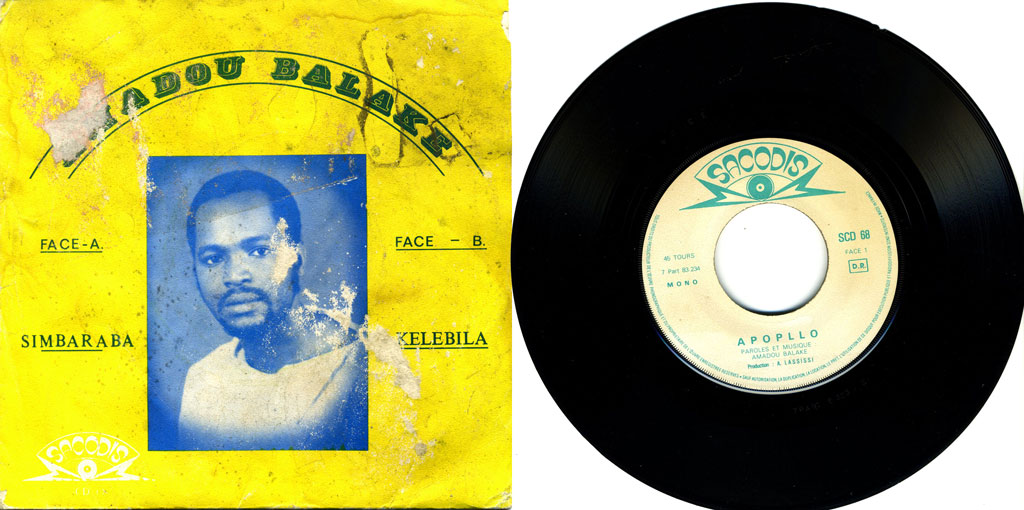
Plus I would like to draw your attention to an anomaly with regard to the titles. On Sacodis SCD 68 the sleeve carries the title "Simbaraba", while the label on the record itself has a title "Apopllo".

A closer study of the song reveals that Ballaké's version bares a strong resemblance to the song "Apollo" by the Horoya Band (Syliphone SYL 535). About the origin of this song I have heard several explanations. Guinean Sekouba Bambino Diabaté claimed that this was a song by his mother, singer Mariama Samoura, when he creatively recycled it into his 'hit single' "Kassouma Ma". Others claim that this song was composed by the Horoya Band to commemorate the Apollo 11 mission in 1969. Personally I suspect Horoya Band were the first to record the song, while it seems possible that Sekouba Bambino's mother was the first to sing it. So both may be true...

Likewise, the B-side of SCD 68, "Kelebila", is a song of which many - mostly traditional - versions exist, and perhaps even more than of "Apollo". I would like to especially mention the version by the legendary Sory Kandia Kouyaté, but I am sure I have heard it on several occasions in Mali (although I can't recall who was singing it...).

One of the great things about Ballaké is his diversity and his capacity to shine in any musical style. While SCD 68 contains Mandé (malinke, mandingo etc.) style songs, SCD 69 has two tracks in a very different, probably Mossi* style. The song "Warba" always conjures up images of people walking backwards, while "Liguiry" evokes the contrary: a feeling of running (too) fast down a hill....

I sincerely hope more Ballaké will surface in the future. I for one will be looking out for (and forward to) it!

Sacodis SCD 68
Sacodis SCD 69

* and please feel free to correct me if I am wrong!

EDIT August 9, 2015: The links have been renewed!

March 28, 2010

The real Balaké

There is of course only one real Balaké, and that's Amadou Traoré dit Balaké.
To my surprise I have not seen a posting of perhaps his most 'appealing' album: "Amadou Balaké à New York" from 1979. And by "appealing" I mean to western audiences. This album has it all: a good variety of styles, covers of famous songs, a dose of humour, a splashing of dramatics.

It starts with a brilliant follow-up to Balaké's very succesful "Whisky Magnin". This time the topic is not drink but drugs. "Yamba" translates as "happiness", but in this case it is the nickname for "ndaay" (or "daaj") or marijuana. "I can't eat without yamba, I can no longer sleep without yamba, I can no longer work without yamba, I can't talk without yamba". Despite the wordplay with yamba/happiness the tone is more serious than in "Whisky Magnin". Balaké mocks and attacks the young and strong "capable of achieving things for the progress of Africa" for their dependency of the drug.

The second track, "They Loule", has some remarkable similarities with the track "4V" by Les Ambassadeurs Internationaux (posted here and here), which was also recorded in Abidjan, but a year earlier. My guess is that both songs have the same source.

The greatest mystery in the third track, "Ligida Ranba", is in the title (which may suggest that we are dealing with a version of the B-side of CVD 46). Marketing-wise I can't see the purpose of trying to hide that this is a version of the Cuban classic "El Manisero". But one can rely on Balaké to give even this ultimate example of world music his own authentic Balaké flavouring.

The B-side of the album opens with a dramatic 'slow' "Yele". Inimitably Balaké, shouting, almost roaring, with his ever-present sense for the anecdotal detail.

This is followed by a track in which I suppose you will have some problems recognising the Horoya Band's hit (from Discothèque 74 - SLP 48) "Sasilon". Nevertheless it is a - admittedly cleverly disguised - version, covered in a thick and creamy Balaké sauce (or maybe I should write "salsa").

The last track, "Awa Yiriga", seems to be a reference to songs of the (at that moment not too distant) past. Songs like the ones on the "Taximen" and "Super Bara Kono Mousso" albums of just a year before. Personally I find this my least favourite track, as the arrangment just does not seem to fit with the song.

Sacodis LS 22-79

As an extra special treat I have a track recorded in 1994 in Ouagadougou, of a performance of Amadou Balaké in the local Harlem Bar. It is only one song, and he had worked a lot that day and had - as he claims - "a handicapped voice", but still his singing in this song "Maderi" is fantastic. I am not sure what the joke of the announcer about Balaké spending twenty years in Mecca is about; for some reason, just by looking at him, I can't see Balaké as a devout muslim......
The recording and the wonderful photo were made by Rob Lokin.

Maderi (Harlem Bar, Jan.26, 1994)

EDIT: April 3, 2010: As Aduna (see comments) correctly points out, the titles of two tracks appear to have been switched. The version of "El Manisero" is called "Awa Yiriga", and the last track should be "Ligida Ranba" (and it still doesn't sound like "Ligida Remba" from CVD 46...).

February 15, 2010

Disco time

Let me begin by assuring you that there is nothing wrong with my record player. Also there is no problem with the record itself; it is not one of those slightly oval pressings, or one with a hump.
This is how it is supposed to sound.

Listening to this record by Moussa Doumbia can be an unsettling experience, though. With its unsteady pace, its weirdly mind-piercing organ, its unexpected breaks this 1980 album, released on the Ivorian Sacodis label, is not suitable for listeners with a nervous disposition. And listening to it while in a state of inebriation can lead to long lasting mental problems.
Even the three songs which were recently (well alright, not recently - it was nearly three years ago...) included in the CD on the Oriki label, sound different on vinyl.

Of course, in the present-day craving for Afro-funk Moussa Doumbia's music will be labelled as 'funk'. And I am sure he has - like many African artists - been influenced by the Fela Kutis and James Browns of this world. But nevertheless this native from Mali has retained a high level of originality, and arguably even authenticity.
Despite the embellishment Doumbia's singing in the opening track "Houphouet Boigny" is in a relatively normal djeli (or griot) style. And if you listen closely "Samba" is actually the same song as "Samba" by Pivi et les Balladins from Guinea. And "Mokholou" a tune from the broad repertoire of hunters' songs from the Wassoulou, made famous by the great Toumani Koné.

But it does not explain the beginning of "Disco Time".

Personally, I am inclined to favour the B-side. And not just because of the blasting version of "Mokholou", but even more because of "Mamadou Coulibaly" and "Dialaman", - of which "Disco Time" is the instrumental version....

Sacodis LS 28

June 16, 2009

Wasso

I am taking a risk here, in assuming the title of the last track of this lp is misspelt (or misspelled) and the actual title should be "waso" with one "s", meaning "showing off" or "boasting". You will find many songs in Malian music telling you that showing off is not acceptable ("waso magni").

The Rail Band is not one of those bands that can be accused of showing off. On the contrary, they have been very modest in the long time of their existence. Forever linked to their 'alumni' Mory Kanté and Salif Keita (and the latter only was a member for two years!), the band has struggled through the decades, playing at the Buffet de la Gare in the centre of Bamako. And I can assure you that this was not always the 'hottest club in town'....

Lately, with the release of the Belle Epoque series (of which the second is my favourite, by the way) they have been rightly brought into the limelight. But there is still a lot of ground to be covered for a band that has been in existence for 40 years this year.

Consider this album my 'drop in the ocean'. Recorded for the Sacodis label in Abidjan in 1979, it is remarkable how close the orchestra has managed to remain to their live sound. Listening to these tracks I have no problem imagining myself sitting at a table at the Buffet de la Gare, a rapidly warming beer within reach plus the inevitable 'loose women'.... The cool but decisive guitar of Djelimady Tounkara, (the late) Tidiani Koné, who founded the band, dodging around him on sax and leading the horns, the mainly doubled vocals...
It is no wonder they lasted so long!

Sacodis LS-25

April 27, 2009

Sory

You may have been wondering why I haven't posted anything in the last couple of days. I can assure you that lack of material is not an issue (and won't be in the foreseeable future). I have been forced to take it easy, after walking -rather stupidly- into a glass wall nearly a week ago.

I promise you I'll be posting more singles very soon, and I haven't forgotten about Franklin Boukaka or about Le Vieux Lion, but for the moment here is a very short post.

Here is an lp filled with tracks that are bound to bring smiles of recognition on the faces of those who have a reasonable amount of knowledge of the music of Guinea. It contains versions of great tracks like "Apollo" (which Sekou Bambino Diabaté turned into a hit), "Diamaraboy" (which was called "Djama ba labo", when performed by the Horoya Band) and "Moi ça m'en fou", which you will recognise as a track covered by Balla et Ses Balladins, but which according to Graeme Counsel is likely to be a track originally from Côte D'Ivoire.
I leave you to figure out why the other tracks sound familiar.

The artist of this wonderful lp is Kouyaté Sory, who featured on the second volume of "Assalam Aleikoum Africa", - and is not to be confused with Kouyaté Sory Kandia. Listening to the music this is not very likely: this Sory is no belcanto vocalist, but rather a one-man-band on the electric guitar.

By the way: note that this appears to be the first record on the Sacodis label!

Sacodis LS 1-77

February 25, 2009

Musica Exotica

Dave van Dijk, one of the pioneers on Dutch radio of black music in general and latin and african music in particular, has died yesterday. He had been ill for quite a while.

For a lot of music lovers in the Netherlands in the 1980s Dave's radio show "Musica Exotica" was the first introduction into new and exciting music styles. Although broadcast initially in the middle of the night (but always live!), the show soon gathered a loyal group of followers. Dave's expertise lay primarily in latin and salsa music, so he invited others to his show with knowledge of other music styles.

Dave was also responsible for a impressive series of live recordings.

To commemorate this radio legend I would like to share this lp from Côte D'Ivoire featuring one of Dave's favourite salsa artists, Monguito El Unico.

This one's for you, Dave.

Sacodis LS 48 (new link April 12, 2015)

November 01, 2008

Eclectico

Ever since I heard about the title of the Amadou Balaké* compilation on Oriki Music (which I have heard since my last post about Balaké and can highly recommend), I have been wondering about the relevance of this title. I mean, is Amadou Balaké "Señor Eclectico"?

If you're interested in reading about eclecticism, here is an interesting entry in the wikipedia.
I prefer to think of Amadou Balaké as an artist who has succeeded in staying close to his public. He has a high level of 'street cred', if you like. This is reflected in his songs. They are about normal people in normal situations.

Like in the song "N'Kanan Djanfa" on this third volume from 1979 on the Sacodis label, where Balaké is a woman addressing the musician Balaké to tell him she has found someone better. Or on "Soum Grouba" where Balaké is a woman who finds herself forced to prostitute herself and has to argue about the price.

What can I say? Eclectic or authentic, just go and buy the Oriki CD!


*Amadou seems to have lost an "l" over the years.....