Showing posts sorted by relevance for query Horoya. Sort by date Show all posts

June 10, 2009

Horoya live

This post is partly intended to point you into the direction of some very interesting videos, which have been uploaded to YouTube by Graeme Counsel (of the very instructive RadioAfrica website). Specifically I am referring to this superb video by the Horoya Band, recorded by Graeme in October 2008. The video offers proof that the Horoya Band is still very much alive and going very strong! I can't tell you how elated I felt when I saw this video. It means there is still hope I will be able to see this legendary orchestra. Judging by their performance in this video, I am expecting to be seriously steamrollered by them.

Graeme has since disabled playback on other websites, but the video is still available and can still be seen by clicking on the link below this image from the video..

In the second part of this post I would like to carry on where I left off in an earlier post, i.e. with the Horoya Band in their mid-1980s glory. This cassette was brought back from Guinea in 1986, and features some tracks which I would label as classics from the post-Syliphone era. The track "Hakilimaya" has been released on some lp's too (which were mostly credited to Conde Demba 'chanteur du Horoya Band'). The quality of the recording is not very good, but the music - live and steaming - is brilliant.

Horoya live

PS: There are more great videos from Guinea on the RadioAfrica video page!!

June 06, 2010

Ballaké (re)visited

I always get a little depressed when I have to report that another one of my musical heroes has passed away. Maybe this has to do with the realisation of my own mortality, - who knows?

On the other hand it is very good to hear that others are still alive and well. As is the case with our musical hero from Burkina Faso: Amadou Ballaké. I received a mail from the very active french writer and 'voyageur' Florent Mazzoleni, who has recently visited Ballaké at his home and sent me these two photos of a very relaxed looking grand maître.

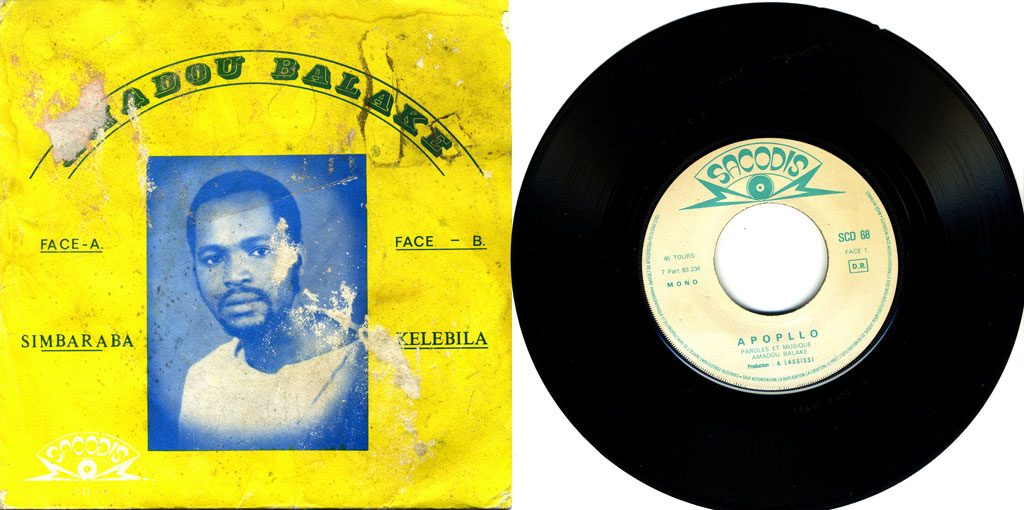
It seems a good idea to grab this opportunity to post two singles which have been posted earlier on the unrelentingly brilliant Orogod blog. In my humble opinion it appears to me that the copies I have of these singles are slightly better than Oro's.

Plus I would like to draw your attention to an anomaly with regard to the titles. On Sacodis SCD 68 the sleeve carries the title "Simbaraba", while the label on the record itself has a title "Apopllo".

A closer study of the song reveals that Ballaké's version bares a strong resemblance to the song "Apollo" by the Horoya Band (Syliphone SYL 535). About the origin of this song I have heard several explanations. Guinean Sekouba Bambino Diabaté claimed that this was a song by his mother, singer Mariama Samoura, when he creatively recycled it into his 'hit single' "Kassouma Ma". Others claim that this song was composed by the Horoya Band to commemorate the Apollo 11 mission in 1969. Personally I suspect Horoya Band were the first to record the song, while it seems possible that Sekouba Bambino's mother was the first to sing it. So both may be true...

Likewise, the B-side of SCD 68, "Kelebila", is a song of which many - mostly traditional - versions exist, and perhaps even more than of "Apollo". I would like to especially mention the version by the legendary Sory Kandia Kouyaté, but I am sure I have heard it on several occasions in Mali (although I can't recall who was singing it...).

One of the great things about Ballaké is his diversity and his capacity to shine in any musical style. While SCD 68 contains Mandé (malinke, mandingo etc.) style songs, SCD 69 has two tracks in a very different, probably Mossi* style. The song "Warba" always conjures up images of people walking backwards, while "Liguiry" evokes the contrary: a feeling of running (too) fast down a hill....

I sincerely hope more Ballaké will surface in the future. I for one will be looking out for (and forward to) it!

Sacodis SCD 68
Sacodis SCD 69

* and please feel free to correct me if I am wrong!

EDIT August 9, 2015: The links have been renewed!

June 25, 2009

Trio fédéral

A few days ago I heard that Stern's are planning another release in their Syliphone series. And -three cheers for Stern's- it will be a double cd of the Horoya Band. That's certainly good news.

In the mean time, and partly as a foretaste of this compilation, here is an album on the Syliphone label with three tracks by the Horoya Band, three by Kebendo Jazz and four (!) by Niandan Jazz. The lp was released, according to the sleeve notes to highlight three of the thirty federal orchestras, which were rising to a level close to that of the five national orchestras. But more remarkably the notes state that these orchestras next (the lp is from 1971) will produce a 'grand volume-identité' to present their musical personality. The only orchestra to in fact produce an entire album after this collection was the Horoya Band, and neither Kebendo Jazz nor Niandan Jazz ever released an lp on the Syliphone label!

If you have read my earlier posts about the Kebendo Jazz you won't be surprised when I tell you the Kebendo tracks are my favourites. "Soumba" is even in the top-ten of favourites of the Syliphone label. Apparently this is a shortened version of a track recorded slightly earlier by Kebendo Jazz (which I pray* will one day be released on CD in its full glory). Hearing the three Kebendo tracks I am again (see this post) left wondering what they did wrong? It can't have been the subjects of their songs; there is enough Sékou Touré, PDG and RDA in them to satisfy even the most orthodox of party members.....

The same, but to a slighty lesser degree, goes for Niandan Jazz. They featured on four compilations (SLP 19, 25 -i.e. this one-, 42 and 50), but never had their own lp. I can't seen why. Their orchestration is simply great, the singing perhaps not top-notch, but still better than others. "Fassouloukou" can compete with any of the songs on the first lp of Super Boiro Band (to name just one of the national orchestras). So where did they screw up?

I am sure you will like this album. I advise you to study the notes with the individual songs. To me they are one of the many attractions of the Syliphone label. But the main attraction remains, of course, that wonderful, incomparable and authentic Syliphone sound!

Syliphone SLP 25

* and don't ask me to whom...

April 14, 2011

Birds

Ballaké at the Harlem Bar, 1994 (photo: Rob Lokin)
While searching on the net for a better copy of the sleeve of this album I stumbled upon many examples of disinformation about this star of Burkinabé music. Sometimes the fragments of disinformation get combined in copying. I read for example that he was a founding member of the Horoya Band de Ségou.
I don't claim to have the final truth when it comes to the biography of Amadou Traoré dit Ballaké, but given the testimony from Guinean artists gathered by Graeme Counsel it seems unlikely that he was a member of the Horoya Band (an orchestra originally from Kankan, Guinea), let alone of the/an orchestra from Ségou, Mali. The confusion may have arisen from the name of the orchestra he did join: the Bafing Jazz from Mamou, Guinea.

More biographic detail in my earlier post here.

I was reminded recently that this album has so far not been posted on any of the (fortunately numerous) blogs dedicated to African music. I have to admit I am not able to follow all the blogs, so I still may be wrong. But it seems such a great omission that I felt it my duty almost to step in, and share this classic album by one of my musical heroes.

The album is another, and perhaps even the best, example of Ballaké's street credibility. He follows the trend to add elements of funk, James Brown and afrobeat to his music, but still manages to remain authentically Burkinabé. What may appear as pure funk, is in fact based on existing (mainly Mossi) traditional rhythms. As for the lyrics, Ballaké is - as always - inspired by the ordinary man and woman in the street. The "bar konon mousso" (literally "bar bird woman") refers to the women serving in bars. Ballaké sings about the hardships they have to suffer and the 'excursions' they have to make to earn a few extra francs. Going by this article (not only was it in french, it has also disappeared!) their situation - over 30 years later - remains unchanged.

I especially like the way in which Ballaké describes his own position in relation to these "birds". The bar kono mousso tells him: "Ballaké leave me alone. You don't have money. Musician, that's nobody*. You're a poor boy."

I'm sure the other songs on this album have similar - or perhaps even more notable - lyrical highlights.

Musically this is no less of a treasure trove. It may take a while for the penny to drop with some of these songs, but when it does I am sure the whole album will embed itself in your musical memory forever. The brilliantly manic "Nabacouboury", the head-over-heels "Dounignamou", the almost Guadeloupean "Balake Ya Mariama", they all have one thing in common: the powerful presence of the great Amadou Ballaké.

Sacodis LS 8-78 or here (MF)

Going through my archives, I discovered a copy of an older version of "Bar Konon Mousso". Despite the rather scratchy condition of this single, released on the Club Voltaïque du Disque label, I am inclined to prefer this version to the version on the Sacodis lp. The tempo seems more fitting to the theme of the song, and the ambience is more 'bar-like'. The lyrics appear to be exactly the same as the later version. The condition of the vinyl is more annoying on the A-side "Absetou", especially as this song has some (seemingly?) nice instrumental bits.

Club Voltaïque du Disque CVD 44 or here (MF)

*"c'est pas quelqu'un", where a "quelqu'un" is a 'somebody', and a "grand quelqu'un" is an important person.

October 03, 2008

Nanfoule

Some say the original is by Mahawa Kouyaté, but I think it's a traditional.

Balla et ses Balladins have a version, but it hasn't been included on the (nevertheless) brilliant collection from Stern's. And that's the only version on the Syliphone label.

A quick search on the web reveals a rap version (using the version by Morydjeli Deen Kouyaté*), a version categorized under Papua New Guinea and a few more.

Here are two more versions: the first is by the Simandou Jazz de Beyla (broadcasted on April 3, 1986 by the RTG), the second is a superb instrumental version by the Horoya Band. It's from a cassette attributed to the 'Horiya Band', which appears to be an attempt by a few of Horoya's musicians to survive in the post-Syliphone era. It's one of my favorite non-Syliphone cassettes from Guinea, - so I have included the whole cassette.


*I'll come back to him in a later post

EDIT (March 4, 2010): extra link

November 06, 2010

Wara

Let me begin by apologising: this is probably the worst cassette of the Horoya Band I have. The sound is somewhere between medium wave and shortwave radio, including some of the wave effects.

But the music...

The bootlegger responsible for this cassette, which was bought in Guinea in 1988, has made a few minor errors (nothing compared to what some of the 'reputable' European producers have conjured up) in writing down the titles, because the first track is clearly "Sasilon", which can be found on Discothèque 74 (SLP 48). But the title of the second track is not "Keme Bourema", but "Wara" (lion). And this is one of these rare tracks that will last you a lifetime. Even after over twenty years this brilliant interpretation of this malinké classic by this exceptional orchestra from Kankan still manages to grab me straight by the throat, right from that majestic beginning to the tragically sudden fade-out, after nearly twelve minutes of pure bliss. I particularly would like to draw your attention to the exemplary rhythm guitar playing.
And it doesn't stop there.

The B-side opens with another classic: "Baninde" (child of the Bani river). Another proof that the border between Guinea and Mali is not a cultural border, because this is a song from the repertoire of the griots of Kela, and more specifically a song generally associated with the legendary Siramori Diabaté. Judging by the fact Horoya also covered her "Kanimba", this can't be a coincidence.
You have to fill in the sound of the fantastic horn section from memory*, but this is certainly one of my favourite versions of "Baninde", and certainly more 'majestic' than the mid-tempo(but also great!) version by Les Messagers.

The second track, "Famadenke", is another malinké classic. The link to Sékou Touré is even more apparent in this song, as it is an ode to Samory Touré's son. This site (or English) not only gives an explanation of the song, but also a translation.

The last track again features on one of the Syliphone collections, in this case Discothèque 75 (SLP 49). Going by the overall sound I think all of the tracks of this cassettes are roughly from the same period (the mid-1970s). And this brings me to the main mystery behind this cassette: what happened to the three tracks (i.e. "Wara", "Baninde" and "Famadenke")? Why were these brilliant songs never released on the Syliphone label?

GD 7051 cassette

* for those with a sudden attack of memory loss, and those who have erroneously purchased the Syllart re-editions, here are "Sasilon" and "Artistes" from SLP 48 and SLP 49.

December 24, 2008

Porcupine

As promised another post about Amadou Balaké.
First I would like to refer you to a biography by Joachim Vokouma on LeFaso.net. It is in French, so here is a partial translation:
His adventure as professional musician starts off in 1962, in Mali. He's enlisted into the orchestra of the Grand Hotel, that plays every night in the Moulin Rouge, a night club in Bamako.

In 1963 he leaves the Malian capital and finishes up in Abidjan, where he plays, with Italians, at the Tropicana, in the Ivoire hotel. The collabaration lasts a mere six months and our adventurer decides to leave for Guinea. Thanks to the good care of a (lady) friend who is a member of the bureau politique of the PDG (Parti Démocratique de Guinée), the single party at the time, he is appointed chef d'orchestre of the Horoya Band from Kankan.

Very soon, the relations between this 'married lady' and her protégé take on a nature which hardly pleases the latter. In the end he decides to pack his bags, and sets off, first to Conakry, and subsequently to Mamou where, in charge of the Bafing Jazz, he participates in artistic competitions. He is invited regularly to perform at the meetings organized by the president Sékou Touré in the interior of the country.

In the first years after independence, the relationship of the Guinean leader Sékou Touré with some of his African counterparts is very low, in particular with the presidents Félix Houphouët-Boigny of Ivory Coast, Maurice Yaméogo of Upper Volta (the present Burkina Faso) and Léopold Sédar Senghor of Senegal. Amadou Traoré will be a victim of this hate between the socialist camp and that of the pro-western (leaders).

Denouncing his great closeness to the former colonial power, Sékou Touré refers to the Ivorian president as a lackey of French imperialism, hostile to African unity. In defense of Houphouët-Boigny, the president of Upper-Volta replies and calls Sékou Touré a representative of communism, the real enemy of the Africans. On the airwaves of the national radio he attacks Sékou Touré in terms of a coarse nature unworthy of a head of state. "Who is this Sékou, also known as Touré, who longs so much that we talk about him? An arrogant man, a liar, jealous, envious, brutal, hypocrite, ungrateful, intellectually dishonest... You're nothing but a bastard amongst the bastards that populate the world. That's what you are, Sékou, a bastard of bastards."

On this the entourage of Sékou Touré turnes to Amadou Traoré and asks him to compose a song in response to the president of Upper-Volta who, in the eyes of Sékou Touré is nothing but a "travelling salesman for the division Africa and an errant boy of Houphouët-Boigny". Which he refuses. "How can I return home (to my country) if I insult my president", he justifies himself. Seeing the clouds appear on the horizon, Amadou Traoré asks and is granted a meeting with the Guinean number one and expresses his wish to go back to see his mother. Much to his surprise, Sékou Touré doesn't object, even offers him travellers cheques, as the Guinean franc was not convertible.

Back in his country he joins the Harmonique Voltaique where he has played before leaving his country and which is now directed by Maurice Simporé. The song he composes, "Balaké", which signifies "porcupine" in mandingue (Malinké), is a hit, mediawise and commercial in several African countries. Ever since, he is called "Balaké".

This sudden succes was however going cause him trouble. According to Amadou Balaké, Maurice Simporé "chased me out of the group arguing that the Harmonique Voltaïque isn't a mandingue orchestra. A false pretext, because in fact he was jealous of my popularity", he believes.

With his experience as a worker in Civil Engineering, Amadou Balaké is recruited by ITS, a German company that in 1969 has taken on the asphalting of the road from Ouagadougou to Pô. As a result of an accident at work Amadou Balaké breaks his right leg and he feels more or less condemned to make a succes of his musical career. In 1970, he forms a group called "Les 5 Consuls de Balaké" that brighten up the evenings at the Don Camillo, then located not far from cinema Rialé.

In 1971 he records an lp "Mdolla Yacouba" ("my lover Yacouba") with Adama Ouédraogo, boss of the Club Voltaïque de Disques. Next he is recruited by a young Nigerian producer residing in Abidjan, Aboudou Lassissi, whose financial proposals were not uninteresting. With him, Amadou Balaké records (in Ibadan) "Taximan n'est pas gentil", which was very well received by press and public.
Unfortunately the biography speeds up immensely in 1971, because the encounter with Lassissi is, if I am not mistaken, at least five or six years later.

I would like to focus in this post on some recordings made between 1971 and 1976 at the Club Voltaïque de Disques of Adama Ouédraogo.

Disques CVD 46:
This record contains a song dedicated to the memory of Aboubacar 'Demba' Camara (the legendary singer of Bembeya Jazz who was killed in a car crash on April 5, 1973), with several quotes from Demba's songs. The B-side is not a version of the track on Amadou Balaké à New York (LS 22-79), but a track in the 'funky' style of "Super Bar Konon Moussou" and others, composed by a certain Abdoulaye Derme.


Disques CVD 48:
Balaké accompanied by the Volta Jazz orchestra in a track that reminds me more of Malian orchestras (apart from the Demba-like exlamations), and with what sounds like a typical Balaké story. The track is covered on the cassette I posted earlier. The track "Johnny" on the B-side appears to deal with a similar subject of 'tough guys'.


Disques CVD 52:
On the A-side the brilliant original of the song he covered in 1981 on the Afro-Charanga lp. Even the guitarist seems inebriated. And on the B-side a song in Balaké thanks his woman for cleaning his clothes and preparing his meals (with a revealing line: "Ma femme ne sort pas la nuit, elle est toujours pour moi" - "my wife doesn't go out at night, she is always mine").


Another original version, but this time of the Africando hit "Betece" (or should I say "Motécé"?). Great track. The B-side was covered several times as "Voiture D'Occasion" (Zamidou Prod. 1582, 1981) and "Super Mobili Occasion" (on the CVD 008 lp).


Disques CVD 66:
Balaké is not mentioned on the sleeve, but does sing the lead on both tracks. I think it's safe to assume Mangue Kondé is the guitarist...


Disques CVD 83:
On the A-side all the ingredients of tracks like "Taximen" are present, albeit with a more pronounced horn section. The B-side is a familiar sounding (but I can't recall where I heard it before) version of the Malinké track.


A special christmassy thanks to Faas T. for these great 45s.


EDIT (Jan.4, 2009): Lamine Camara, the present chef d'orchestre of the Horoya Band, is quite definite about Amadou Balaké never being a member of the orchestra, let alone chef d'orchestre, reports Graeme Counsel (I asked him to check this).

March 28, 2010

The real Balaké

There is of course only one real Balaké, and that's Amadou Traoré dit Balaké.
To my surprise I have not seen a posting of perhaps his most 'appealing' album: "Amadou Balaké à New York" from 1979. And by "appealing" I mean to western audiences. This album has it all: a good variety of styles, covers of famous songs, a dose of humour, a splashing of dramatics.

It starts with a brilliant follow-up to Balaké's very succesful "Whisky Magnin". This time the topic is not drink but drugs. "Yamba" translates as "happiness", but in this case it is the nickname for "ndaay" (or "daaj") or marijuana. "I can't eat without yamba, I can no longer sleep without yamba, I can no longer work without yamba, I can't talk without yamba". Despite the wordplay with yamba/happiness the tone is more serious than in "Whisky Magnin". Balaké mocks and attacks the young and strong "capable of achieving things for the progress of Africa" for their dependency of the drug.

The second track, "They Loule", has some remarkable similarities with the track "4V" by Les Ambassadeurs Internationaux (posted here and here), which was also recorded in Abidjan, but a year earlier. My guess is that both songs have the same source.

The greatest mystery in the third track, "Ligida Ranba", is in the title (which may suggest that we are dealing with a version of the B-side of CVD 46). Marketing-wise I can't see the purpose of trying to hide that this is a version of the Cuban classic "El Manisero". But one can rely on Balaké to give even this ultimate example of world music his own authentic Balaké flavouring.

The B-side of the album opens with a dramatic 'slow' "Yele". Inimitably Balaké, shouting, almost roaring, with his ever-present sense for the anecdotal detail.

This is followed by a track in which I suppose you will have some problems recognising the Horoya Band's hit (from Discothèque 74 - SLP 48) "Sasilon". Nevertheless it is a - admittedly cleverly disguised - version, covered in a thick and creamy Balaké sauce (or maybe I should write "salsa").

The last track, "Awa Yiriga", seems to be a reference to songs of the (at that moment not too distant) past. Songs like the ones on the "Taximen" and "Super Bara Kono Mousso" albums of just a year before. Personally I find this my least favourite track, as the arrangment just does not seem to fit with the song.

Sacodis LS 22-79

As an extra special treat I have a track recorded in 1994 in Ouagadougou, of a performance of Amadou Balaké in the local Harlem Bar. It is only one song, and he had worked a lot that day and had - as he claims - "a handicapped voice", but still his singing in this song "Maderi" is fantastic. I am not sure what the joke of the announcer about Balaké spending twenty years in Mecca is about; for some reason, just by looking at him, I can't see Balaké as a devout muslim......
The recording and the wonderful photo were made by Rob Lokin.

Maderi (Harlem Bar, Jan.26, 1994)

EDIT: April 3, 2010: As Aduna (see comments) correctly points out, the titles of two tracks appear to have been switched. The version of "El Manisero" is called "Awa Yiriga", and the last track should be "Ligida Ranba" (and it still doesn't sound like "Ligida Remba" from CVD 46...).

April 27, 2009

Sory

You may have been wondering why I haven't posted anything in the last couple of days. I can assure you that lack of material is not an issue (and won't be in the foreseeable future). I have been forced to take it easy, after walking -rather stupidly- into a glass wall nearly a week ago.

I promise you I'll be posting more singles very soon, and I haven't forgotten about Franklin Boukaka or about Le Vieux Lion, but for the moment here is a very short post.

Here is an lp filled with tracks that are bound to bring smiles of recognition on the faces of those who have a reasonable amount of knowledge of the music of Guinea. It contains versions of great tracks like "Apollo" (which Sekou Bambino Diabaté turned into a hit), "Diamaraboy" (which was called "Djama ba labo", when performed by the Horoya Band and "Moi ça m'en fou", which you will recognise as a track covered by Balla et Ses Balladins, but which according to Graeme Counsel is likely to be a track originally from Côte D'Ivoire.
I leave you to figure out why the other tracks sound familiar.

The artist of this wonderful lp is Kouyaté Sory, who featured on the second volume of "Assalam Aleikoum Africa", - and is not to be confused with Kouyaté Sory Kandia. Listening to the music this is not very likely: this Sory is no belcanto vocalist, but rather a one-man-band on the electric guitar.

By the way: note that this appears to be the first record on the Sacodis label!

Sacodis LS 1-77

June 19, 2009

Siramori's Sara

I can be very short about this cassette. If you want to read about the legendary artist recorded on it, I refer you to the expert, i.e. this concise article by Jan Jansen (also available here, - in case the link goes dead...).

There is no doubt about Siramori Diabaté's status as a musical legend. You just have to listen to this cassette to understand that this status is completely justified. The intensity and profound emotion in her hoarse voice can't help but move even the coldest of humans.

Most, if not all of these tracks have been covered innumeral times by others. "Sara" most famously (and twice) by Balla et ses Balladins; of "Baninde" a great version by Les Messagers du Mali comes to mind; "Kanimba" was covered impressively by the Horoya Band.

Don't forget to read Jan Jansen's article.

Syllart SYL 83106

July 27, 2009

Regard sur le passé

To any connoisseur of West-African music the title of this post must at least sound familiar. And I am sure most will recognise it as the title of a classic album by Bembeya Jazz National, in which the legendary singer Aboubacar Demba Camara recounted the epic story of Sekou Touré's grandfather, Samory Touré, and his heroic struggle against the French colonial oppressors. The album was released twice on the Syliphone label, or three times if you count the live version recorded in Abidjan.
The success of the Bembeya tale provoke a lot of orchestras to follow the Regard formula, and evoke tales of other glorious and heroic pasts. The Horoya Band had its own versions with "Tunyalee" and "Boloba", and the Dirou Band followed suit with "L'Arbre Eternel".

The formula soon caught on in other countries, and more particular in the country with which Guinea shares culture and a large part of its history: Mali. Soon Malian audiences too were glowing with pride on hearing the musical accounts of the intrepid endeavours of Great Ancestors like Soundiata Keita, Da Monzon Diarra and Bakari Dian Koné. I have been assured that most of these epics have never made it to vinyl (and certainly not the many regional versions).

But the great version of the epic of Bakari Dian, gloriously performed by Biton National de Ségou and masterfully recorded at the Radio Mali, did, - and was released on the first lp of Mali's own Mali Music label*.

Besides Biton the lp contains tracks by the Rail Band, the Orchestre de Gao and two tracks by the Tjiwara Band de Kati. Of these the track by the Orchestre from Gao offers another link to the Guinea of Sekou Touré with a song in the Regard style about the attack led by Portuguese officers on Novembre 22, 1970.
The Rail Band song is an ode to the band's founder and sax player, Tidiani Koné.
The two tracks by the Tjiwara Band can perhaps not compete with the superior standard set by Biton and the Rail Band, but have become -over time- historic proof of the overall high level of Malian orchestras.

Mali Music Mali 1001

* "Da Monzon", albeit a comparatively short version, was also released on the Orchestre Régional de Ségou lp released on the Bärenreiter-Musicaphon label. I will post a version of this without the irritating applause later.

October 03, 2009

9ème Festival

Is nostalgia the longing for a past one has personally experienced, or is it possible to yearn for events of which one was completely unaware at the time when they happened? I ask this, because I experience an extreme attack of nostalgia whenever I read about the 9th Festival National des Arts et de la Culture. The event took place from March 4 to 22, 1973, in Conakry, the capital of Guinea.
I have a strong tendency to burst out in tears even when I only read the programme:
● the 7 nationals orchestras*
● 30 federal orchestras
● the Tout Puissant O.K. Jazz (in 1973!!)
● Myriam Makeba and the Quintette Guineen
● Orquesta Aragon from Cuba.

Of the "inoubliable show global" of the T.P. O.K. Jazz not even a memory remains in present-day Guinea (and I am still hoping someone proves me wrong!). But luckily there is this great album on the Syliphone label which gives us at least a glimpse of the Greatness of this 9th Festival. Although it "only" features tracks from the regional orchestras, it is still one of my favourite lp's on the Syliphone label.

The album contains some brilliant contributions from Nimba Jazz (later known as "Le Nimba de N’zérékoré"), from Kébali Jazz from Dinguiraye, Niandan Jazz from Kissidougou (two tracks), Kakandé Jazz from Boké, Télé-Jazz from Télémélé, Kalum Star from Conakry I, "22 Novembre" Band from Kankan, Dirou Band from Kindia and Palm Jazz from Macenta. There are no "weaker" tracks on this lp. Tracks which may seem 'inferior' initially will grow after hearing them a few times.
But this said, I do have some favourites: "Wara" (Nimba Jazz) with the great interaction between guitars and balafon; Kakandé Jazz's uptempo "Nkhama Gnakha" with its enthusiastic horns; "Djarama Sinta" by Télé Jazz, a favourite for late-night car journeys; Kalum Star's "Lalaba" with its catchy rhythm and great monomaniac rhythm guitar; the "22 Novembre" Band and its "Kouma", I could easily listen to a few albums filled with just that superb band.

Listening to this album I can't help being overwhelmed by a strong sense of nostalgia.

Syliphone SLP 42

* I have no idea what the seventh orchestra was, after (1) Bembeya, (2) Keletigui, (3) Balla, (4) Amazones, (5) Horoya and (6) Boiro Band. Was the Orchestré de la Garde Républicaine 2ème formation still in existence in 1973?