July 22, 2010

Sax & flute jive

Called it synchronicity, call it a coincidence, call it whatever you like: I was busy uploading this cassette when I saw ElectricJive had posted the next volume in this series.

I gladly refer you to ElectricJive's post, and not just for this post.

I can confirm that there are five volumes in this series, and I will post them all, if you are patient. If I remember correctly I bought these cassettes in the early 1980s in a small shop in Soho, London, together with two volumes of Congolese music from the 1950s. Later on I also found a cassette by Monguito El Unico from the (probably) same source. The rest you can read in my earlier post of the first volume.

Even more than the first volume it has taken a while for me to grasp this music. I think it was after my visit to SA in the late 1990s that I could ´translate´ the atmosphere and feel of these recordings, and connect it to the people. Not that could find a lot of this music when I was there, by the way. But that´s another story....

South African Jive Vol.2: Sax & flute jive

July 18, 2010

Renaissance

Having just spent two weeks trying to recover files from a failing & angrily resisting hard disk, I am happy to report that most files have been saved. Only about 2% of the volume was lost.
So I now can get back to the business of sharing some of the forgotten and/or (almost) lost wonders of African (and latin) music with you. And in this case a cassette by a Guinean star who has been the subject of a post in November 2008: Mory Djeli Kouyaté, who used to be nicknamed "Dienne", but later changed this to "Deen".

In my earlier post I stated that Mory Djeli was from Kankan. It appears that this is incorrect: I am told he was born in Siguiri. But he did rise to stardom in the second town of Guinea, Kankan.

It appears to me that this cassette from 1993 was Mory Djeli's first attempt at a break-through on the international market. While the cassette from 1990 which I posted earlier was still devoid of the electronic interventions which seem to tipify recordings made in Parisian studios, this cassette seems to have been the first in which Mory Djeli cooperated with Jean-Philippe Rykiel. A cooperation which, unfortunately, seems to have continued right into the present day.

Personally I am no fan of Mr. Rykiel's meddlings in African music. One of the attractions of (a large part of) African music is the omission, the leaving out of the obvious, the rhythmical gaps, the unsuspected zeros. Mr. Rykiel's synthetic additions fill in these holes like a thick greasy mayonnaise, covering - and in some cases blocking - the subtle tastes of the African ingredients.

It has taken me quite a while to get over the Parisian production of this cassette. But after listening to truckloads of Parisian and Paris-influenced cassettes from west-african artists, my senses seem to have been blunted enough not to be annoyed or irritated by the rykielisation. I have trained my ears not to hear it....

And in hindsight, there have been many cassettes in which the Parisian production is far more pronounced. Even within Mory Djeli's oeuvre, this is one of the more modest productions. The balafon played by M'Mabou Camara and the - at times frenetic - ngoni of Garba Tounkara can still be discerned, and the female chorus sounds far less 'canned' than it does in other productions.
And then there is the winning element of this music: Mory Djeli's brilliant vocals. This man has a Voice.

My favourite songs on this cassette are "I Nagna", "Mory Nikala" and "Telemba". Songs with an enormous drive and with Mory Djeli's power vocals accentuating this drive. In the first track on the B-side pays homage to Amadou Toumani Touré, who at the time had handed back power to the civilian authorities after performing a coup d'état against Moussa Traoré in 1991.

Mory Djeli apparently has made friends in high places. When he fell ill a few years ago, he was sent to Morocco to recover by the then Guinean president Lansana Conté. More recently Mory Djeli, who seems to have acquired the nickname of "Bélébéléba de la musique guinéenne" ("Big - or literally: fat - man of Guinean music"), with his latest album "Sauvons La Guinée" ("Let's save Guinea") appears to have taken on the task of restoring order and peace in his home country.....

Sona Store Production 2091

As a bonus I am adding a track recorded live in Conakry (and broadcasted on Dutch radio some years ago), just to give you an idea of what Mory Djeli could sound like without the Parisian production....

Mory Djeli live

July 06, 2010

July 6, 1938


It is exactly 72 years ago today that one of the greatest stars of African music was born in Sona-Bata, Congo: François Luambo, who within 16 years became a phenomenon in Congolese music and whose 'stagename' Franco even today, nearly 21 years after his death, is inextricably linked to modern Congolese music and African music in general.

As an ode to this grand master I would like to share with you this rare album, released in Côte D'Ivoire on the Disco Stock label.
I can assure you it is pure coincidence (ahum) that the album has an orange sleeve.....

The lp contains twelve tracks from the 1950s. Although the title of the lp is "Le bon vieux temps de l'O.K. Jazz" ("the good old days of the O.K. Jazz"), there is in fact one track which was recorded in the time before the foundation of the O.K. Jazz. "Elo Mama" (titled "Mama Elo" on this lp) was released in March 1956, i.e. three months before the birth of O.K. Jazz. Just nine months later the O.K. Jazz produced such miraculously brilliant tracks as "Venga De Priza" (called "Del Prison" on this lp). And again nine months later they gave birth to "Linga Ngai Tolinga Ye" (erroneously titled "Linga Ye To Oling Ngai" on this lp), a bolero which has occupied a steady position in the top of my favourite songs for nearly twenty years now, followed two months later by "Zonga Vonvon Melancolie" (mauled into "Mboka Yo Okeyi Mosika" here). Both tracks contributed to Franco's status as the real and undisputed sorcerer of the guitar, who was capable of touching emotional strings others had even never heard of.

The 'most recent' of these compositions, all by Franco himself by the way, is from January 1959, and is proof of the subtle maturation of Franco's guitar playing. "Mbongo Na Ngai Judas" ("Judas" has disappeared in the title on the lp), no doubt about the silverlings which Judas received for betraying Jesus, is actually the A-side of another out-of-this-world composition by Franco: "Ndokoyo" ("this sorcerer").

Some of these tracks were released (and generally in a better quality) on various lp's on the African label, but songs like the ones I mentioned more than amply make up for the redundancy of those.

DS 7950 or DS 7950

PS: I have added a list of the correct titles.

July 04, 2010

50 Years

Four days ago I had finally found some time to sit down (overcoming obstacles like the sweltering heat and family members claiming attention) and started writing this post when my computer without any kind of warning shut down and rebooted. After the initial stages of panic and uncontrolled swearing I discovered that another hard disk had committed suicide. Having just overcome the loss of a hard disk of exactly the same brand, type and size you can imagine that my trust in the Korean manufacturer of this hardware has come to an all-time low. I am still in the process in trying to recover the most essential files (and unfortunately in this case some irreplaceable audio...) from the disk.
Anyway, here is the post I was writing a few days ago.

It may have escaped your notice, but on June 30 it was exactly 50 years ago that Congo regained its independence. And in writing this I realise that this is a historic inaccuracy, as Congo never existed as a 'modern' state before King Leopold claimed it as his private property in the 1870s.
For the Congolese the late 1950s were a period of great expectations, and perhaps even greater promises. Musically the preparations for independence had started way back in the late 1940s, when the first recordings were made of 'native' artists. The development of a local music business in the 1950s coincided the rise of the 'évolués', i.e. the 'civilised native', who had been educated in the western ways by the Belgians colonisers.

Perhaps the best-known musical exponent of this new middle class was Joseph Kabasélé, who later became known as Le Grand Kallé. Educated by the Belgians missionaries and having set his first steps on the musical path as a choirboy, Kabasélé had ambitions to become the Congolese equivalent of a French chansonnier. In 1951 Kabasélé started hanging out at the Opika studio of the Lebanese Benetar brothers. And as he was consider something of an intellectual, having had slightly more schooling than the average pre-independence Congolese, and as he had the good looks to attract a female audience, he was soon invited to join the then leading performers of the Opika label as a singer. After some hesitant songs with Georges Doula (which I will post later), Kabasélé soon gained confidence and started delivering some of the hits which soon made him the star of the Opika label, and would lay the foundation for the African Jazz school* of Congolese music.
It is hard to pinpoint the date when the band African Jazz was founded. Some sources say that the name was used as early as 1952. Others link the name to the recordings in which Belgian sax player Fud Candrix played with the Opika musicians, including a session with Kabasélé which definitely put the turbo on Kallé's career (subject of a future post). Alternatively the foundation is linked to the recording of the song "African Jazz", - which happens to be on the lp I would like to share with you in this post.

The lp is a collection of songs from the 1950s and early 1960s, with five tracks originally recorded for the Opika label (a6 and b1 to b4) and seven recorded for the Esengo label. One of the Esengo tracks may seem out of place, not only because it doesn't feature African Jazz or Kabasélé, but also because it is sung by Rossignol (accompanied by Rock-a-Mambo), who was an exponent of the O.K. Jazz school. But Rossignol had moved to Esengo when it was founded on January 1, 1957, and recordings were made in various 'line-ups'.

You may recognise the track "African Jazz" from the 'exotic' East-German record I posted earlier.
The version of "Kay Kay" ("Kai Kai" on the sleeve), 'borrowed' by Nico** from the Cuban classic "La Galletana" (which I suspect was originally recorded by Orquesta America del 55' in 1957), is the oldest version. It was later re-recorded for the Surboum African Jazz label.
I think two of the Opika tracks, "Kele" and "Napekisi Yo Mo Nalingi Yo", are with Fud Candrix on sax, and two are clearly (he is named!) with the Rhodesian sax player Isaac Musekiwa, who had been dug up from (then) Elisabethville (Lubumbashi) to replace Candrix. In the fifth track another Belgian can be heard: Gilbert Warnant, a radio journalist, who helped out the Benetar brothers not only as a talent scout, but also as a Solovox (organ) player.

All in all this is a great collection, with a fine overview of Kallé's work in the 1950s and early 1960s. All tracks are great, but some are perhaps even greater. Charles Kibongue's "Ngai Mpe Elombe" is one of these, with its driving rhythm and almost manic guitar playing. And "Ba Nzambe" ("God's people"), with its dense orchestration. And "Napekisi Yo Mo Nalingi Yo" is one of these songs that has been sung to me by several Congolese when they - often with great nostalgia - recalled le bon vieux temps of the early African Jazz......

AJM 005

* Franco once described the difference between his O.K. Jazz school and the African Jazz school as "a matter of influences": the African Jazz school has tended to incorporate more foreign (French, latin) influences, while the O.K. Jazz has predominantly been inspired by Congolese sources.
** and which was once - with considerable pride - named as Nico's greatest composition by a man who claimed to be Nico's nephew.

June 18, 2010

Vedette

You may remember Wande Kouyaté from an earlier post on this blog, but I doubt you would guess this is the same artist just by listening to the music. While the cassette I posted earlier had a lusciously rich and 'live' ambience, the sound on this cassette is bone dry. This is partly due to the accompagnement by none other than the legendary Vieux Lion himself, Bazoumanaba Sissoko.

Wande Kouyaté, like many of Mali's divas, saw her career lift off through her involvement with the Ensemble Instrumental National. In this she followed in the footsteps of her mother Bah Tounkara, who was a member of the very first Ensemble.
But it is safe to say that Wande is not one of the most popular djeli's in Mali. When I bought this cassette in the 1980s some Malians praised her for her pure interpretation of traditional classics, while others argued she was too intellectual (or even intellectualistic) to be loved by the masses, and her repertoire tended to be conservative or even dogmatic (if this is possible in music). I am not sure what 'won her over', but it is clear that she modernised her style sometime during the 1990s, - although she managed to keep the ngoni in.

I don't have a reliable discography (or cassettography) of her work, but I think this must be one of her very first cassettes. These recordings were originally released on Sacodis LS 33 (presumably in 1980), and the tell-tale vinyl scratches and noises* seem to indicate that this cassette is a bootleg ripped from the Sacodis lp.
All the tracks feature only Wande with Bazoumana on ngoni. Highlights to me are the brilliantly pentatonic "Ne Ya Me", "Mali Nieman" and - of course - "Bakari Dian", the epic story about that historic hero from Segou, Bakari Dian Koné.
These are bambara traditionals in their purest form. Bazoumana's ngoni evokes a world far from Parisian studios and hi-tech recording gear. A world of dry sun and good friendly folk. The only drawback is that after listening to this cassette I find myself mysteriously covered in red Malian dust....

ASF 322 cassette


From a later date, but still from the 1980s, here is a video of Wande Kouyaté recorded by Malian television. Unfortunately no Bazoumana, but still a very nice version of a song which is also on the cassette I posted earlier: "Niame". You may be tempted to think "Ne Ya Me" is the same song, but this is clearly not the case. Note the remarkable change in pace set in after 5'40. Being a true vedette of Malian music Wande leads the ensemble....


*including traces of reversed vocals which I can only attribute to an error in the alignment of the recording head when they made the 'mastertape' for this cassette.

June 12, 2010

FC 105

Well, let's get it over with then. I could have posted Osadebe's "Rangers International", "FC Dragons" by Johnny Bokelo or Mokontafe Sako's tribute to "Les Aigles du Mali". But instead I am going to go for a duel between two of the leading figures of the two schools of Congolese music: Franco and his Tout Puissant O.K. Jazz and Tabu Ley Rochereau and his Orchestre Afrisa. Both made a tribute to a Gabonese football team, the Football Canon 105 from Libreville.

Gabon have never qualified for the World Cup. Their team, "Azingo Nationale" (or "Black Panthers"), finished behind Cameroon in the qualification for the 2010 edition, which has started yesterday. They did managed to qualify for the Africa Cup of Nations three times, with their best showing a place in the quarterfinals in 1996. In the 2010 edition they didn't survive the group stage, although they beat Cameroon.
The Black Panthers play their home matches in the Omar Bongo Stadium in Libreville, - which also happens to be the stadium of Gabon's most succesful club: the FC 105 de Libreville. The FC 105, founded in 1975 as the club of the army and the police, was mainly succesful on a national level, winning 11 titles. Their heyday was in the 1980s. They won the championship in 1982, 1983, 1985, 1986 and in 1987.

Given the political situation in Gabon at the time, I am almost certain that president Omar Bongo must have had something to do with this success. And I strongly suspect that he also had a hand in commissioning two of Africa's leading stars to sing in praise of those immortal heroes of the FC 105.

Tabu Ley was the first to receive a commission. He released this lp in 1985, no doubt on the occasion of the fourth championship. In his sleeve notes on the back of this lp Tabu Ley is trying hard to convince us that the release was inspired by his love of football and that the FC 105 had been his team all along. He is careful to avoid mentioning the name of Omar Bongo, even in the name of the stadium (..."dont je tais le nom"). As for the title track, listening to it terrible and traumatic images keep flashin in my mind of le Seigneur dressed in a white sheet prancing 'round the stage in the Melkweg. I have tried to trace the folkloric Gabonese dance "Nzobé" from which the rhythm was borrowed for this track, but have been unable to find a musical example in my collection.
Ley cites FC 105's slogan of "compétence, éfficacité et disponibilité", and names founder, board members and other functionaries with the club, - all signs of a commission....

Personally I prefer the B-side of this lp, which opens with a version of "La beauté d'une femme" sung by Rochereau himself. This song is probably better known in the version sung by Mbilia Bel, which was released shortly after this version. The album is concluded by a track composed by Mekanisi Modero (who happened to feature in the recent Cobantou post).

Genidia GEN 118

Franco's version of "le F.C. 105 de Libreville" was released the same year.
Right from the start of this song it is obvious that Franco's approach of the subject is going to be more subtle. The chorus (heavyweights Josky Kiambukuta, Madilu System and - probably - Lola Djangi Chécain) recalls the foundation of the club, and when the horns set in an anonymous narrator 'officially' (or ceremoniously, if you like) announces the subject of the song. After this impressive opening Franco joins in after two minutes, on guitar first, and after 2'42 on lead vocal.

Tabu Ley once told me in an interview that he started liking Franco's singing in the 1980s. I don't agree; I think he was already a superior backing vocalist, even in the 1950s. And as a lead vocalist he may not have met any belcanto standards, but he certainly succeeded in touching many an emotional button with his audiences. This is, however, not one of Franco's most inspired songs. Like Tabu Ley, he does little more than cite the names of FC 105 big shots and functionaries. In the sebene, after 9'14, the interplay between the guitars is quite interesting, with Franco injecting some short, but clearly recognisable chords.

The B-side features two songs about the darker side of love. The first of these, "Bourreau des coeurs" (which translates as "ladykiller"), was composed by Denis Bonyeme, a singer who Franco had attracted as a (vocal) replacement for Ntesa Dalienst, who had left the T.P. O.K. Jazz in 1984. I can only guess what inspired Bonyeme, and perhaps it is only a coincidence that a french movie with the same name appeared a few years earlier. Curiously the lead vocalist in this song is none other than the man Bonyeme was supposed to replace: Ntesa Dalienst. Although he had moved to Europe, he remained an 'appartenair' (associate) of the O.K. Jazz, and was available for concerts and for recording sessions in the European studios.
Franco's role on guitar was filled in by Thierry Mantuika.

It is also remarkable that Franco played this song during two concerts in the Netherlands in 1984 (one of these - in which Franco himself is playing - can be found here) as well as during a concert in Brussels in 1983, i.e. two years before it was released on lp.

The composer of the last track of this lp is a certain Djo Djo. I don't think this was a member of the orchestra. Perhaps this Djo Djo is singer Djo-Djo Bayingue, who played with Papa Wemba.
Josky, singing the lead, is the main attraction of this song, with the solid chorus coming second.

All and all this is quite a good B-side, and better than a lot of other albums from this period.

Edipop POP 029

Interestingly enough, in 1986 (a year after these albums were released) president Omar Bongo divorced his second wife, Marie Josephine Kama. She moved on to start a career as a singer, under the name of Patience Dabany. I personally only know her of an album in which together with Tabu Ley (!) she sings a song in memory of Franco (!!)....

But getting back to football, I think the winner of this FC 105 match is clearly Franco. Tabu Ley scores points with his B-side, but sadly makes an own-goal with the A-side. Franco not only impresses with some classic team work, but with the star duo Ntesa & Josky scores some serious goals on the B-side....

June 10, 2010

Cobantou

I hope you don't think I am going to go wild posting all kinds of football (soccer) related or South African music. I may be tempted to dedicate one (1) (or perhaps even two) post to football, and South African music is never off the agenda, but I'm afraid I am not going to let an over-commercialised and hyper-hyped media event dictate my blogging agenda (ahum)....

Instead I would like to dig a bit deeper into Congolese music. And in this post I would like to share three singles by Orchestre Cobantou, the orchestra founded and led by Paul Ebengo, better known as Dewayon.

You may recall that Dewayon played a crucial part at the start of Franco's career. Given this shared past, it is not surprising that when Congolese music started to be divided in two sides (or 'schools', or influences), Dewayon and his orchestra were categorised as belonging to the O.K. Jazz school. Nevertheless Dewayon has always managed to retain an authentic sound, at first - after switching from Loningisa to the new Esengo label in 1957 - with his Conga Jazz, and subsequently with Cobantou.

It is a pity that so little has been documented about the history of this orchestra, which over the years saw a great amount of very talented musicians pass through its ranks. It appears that Dewayon had some difficulty retaining these musicians, because I don't think many stayed for very long. One of these talented musicians was guitarist Raymond Brainck, who I mentioned in these earlier posts.

I am not sure when Brainck ceased to be a member. I known he was with Cobantou in the early days of the Londende label.
It is hard to say if he is playing on Londende Lo 040, the first of these three singles, mainly because it is very hard to distinguish any individual member in these two extremely unusual tracks. This may be due to the collaboration with le Groupe Monguande Folklorique, who appear to be doing their own Monguande (does this refer to the Mongo?) thing, while Cobantou are desperately trying to get their bit in....
It is clear, however, that Mobutu is the subject of both songs.

Londende Lo 040

Equally remarkable, but for very different reasons, is the second single, released as Londende Lo 043. The A-side contains a relatively normal rumba composed by Dewayon. In the song some of the members of the orchestra are named. Raymond Brainck is mentioned immediately after Dewayon (1'55 into the song), and they are followed by singer Flamy (Pierre Kiyika a.k.a. Kiyika Masamba) and Gérard (probably sax player Gérard Kongi, and probably not Gérard Madiata), Francky (the great singer Franc Lassan?? or the sax player who played with Nico?), Chécain or Lola Djangi (who switched to the O.K. Jazz in April 1967), singers Champro (often spelled as "Champrou" or even "Champroux") and Emmano Mbala, rhythm guitarist Jacky Mambau, someone called Tollo (who can he mean??), Jean-Paul (or Champro again?), Modero (more than likely sax player Mekanisi Modero, who later played in Tabu Ley's Afrisa) and André Mazi (drummer). Although this summing up of the names of band members may sound narcissistic to present-day western audiences, it was almost a necessity for a lot of African musicians, not only to receive immaterial credit from audiences in a largely oral culture, but also to avoid being excluded when it came to dividing the revenues.
The B-side of this single is again remarkable. Composed (and sung?) by singer Champro it is a french ballad, sung with a frenchness that would have made even Kabasélé jealous. It's a pity the song only lasts 2'22.....

Londende Lo 043

The third single is from a later date; it was originally released as Londende Lo 148. This suggests, by the way, that Cobantou have recorded and released quite a few singles in a short period. I deduce this from the presence of Chécain (standing fourth from the left and audible in the song on side A, and possibly on side B too). Apparently Raymond Brainck had left the orchestra, because Delafrance (before with Nico's African Fiesta) is named as the lead guitarist. I particularly like the A-side "Molangi Ya Pembe Communiqué".

African 90.404 [Londende Lo 148]

Again I invite you to correct, add, comment etcetera. I am trying to help in reconstructing some of the history of these glorious orchestras.

Edit (June 11, 2010): Here are all three singles in one file.

June 06, 2010

Ballaké (re)visited

I always get a little depressed when I have to report that another one of my musical heroes has passed away. Maybe this has to do with the realisation of my own mortality, - who knows?

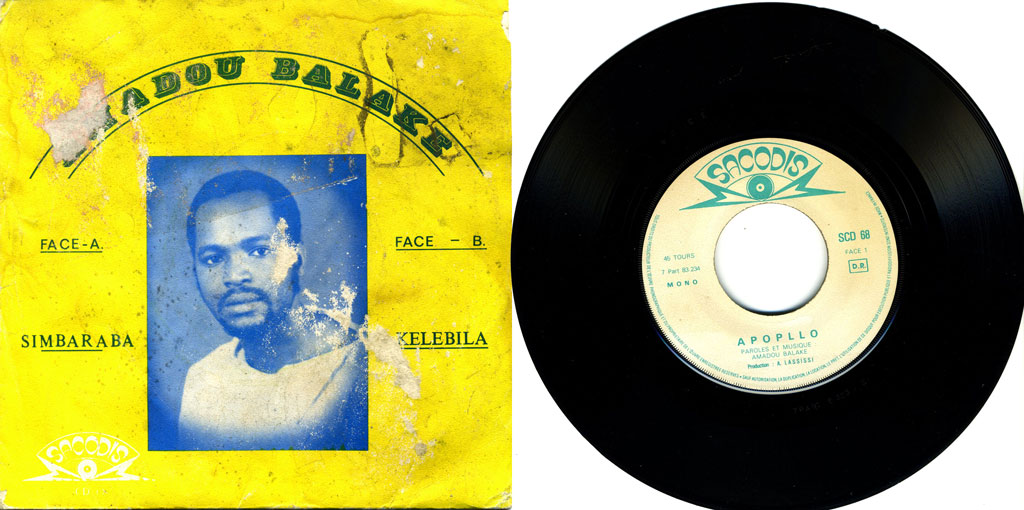
On the other hand it is very good to hear that others are still alive and well. As is the case with our musical hero from Burkina Faso: Amadou Ballaké. I received a mail from the very active french writer and 'voyageur' Florent Mazzoleni, who has recently visited Ballaké at his home and sent me these two photos of a very relaxed looking grand maître.

It seems a good idea to grab this opportunity to post two singles which have been posted earlier on the unrelentingly brilliant Orogod blog. In my humble opinion it appears to me that the copies I have of these singles are slightly better than Oro's.

Plus I would like to draw your attention to an anomaly with regard to the titles. On Sacodis SCD 68 the sleeve carries the title "Simbaraba", while the label on the record itself has a title "Apopllo".

A closer study of the song reveals that Ballaké's version bares a strong resemblance to the song "Apollo" by the Horoya Band (Syliphone SYL 535). About the origin of this song I have heard several explanations. Guinean Sekouba Bambino Diabaté claimed that this was a song by his mother, singer Mariama Samoura, when he creatively recycled it into his 'hit single' "Kassouma Ma". Others claim that this song was composed by the Horoya Band to commemorate the Apollo 11 mission in 1969. Personally I suspect Horoya Band were the first to record the song, while it seems possible that Sekouba Bambino's mother was the first to sing it. So both may be true...

Likewise, the B-side of SCD 68, "Kelebila", is a song of which many - mostly traditional - versions exist, and perhaps even more than of "Apollo". I would like to especially mention the version by the legendary Sory Kandia Kouyaté, but I am sure I have heard it on several occasions in Mali (although I can't recall who was singing it...).

One of the great things about Ballaké is his diversity and his capacity to shine in any musical style. While SCD 68 contains Mandé (malinke, mandingo etc.) style songs, SCD 69 has two tracks in a very different, probably Mossi* style. The song "Warba" always conjures up images of people walking backwards, while "Liguiry" evokes the contrary: a feeling of running (too) fast down a hill....

I sincerely hope more Ballaké will surface in the future. I for one will be looking out for (and forward to) it!

Sacodis SCD 68
Sacodis SCD 69

* and please feel free to correct me if I am wrong!

EDIT August 9, 2015: The links have been renewed!

June 05, 2010

Veux tu danser avec moi?

Having finally recovered from a hard disk crash and with all systems back in working order, I think it may be a good idea to post some more music from that glorious era of Congolese music: the late 1950s and early 1960s.

This time with some more hits from the Ngoma label.

The oldest of these are by Camille Feruzi and his Mystérieux Jazz. Camille Feruzi was born in Stanleyville in 1912. At a very young age he taught himself to play the accordeon, following in his father's footsteps. When his father was at work the young Camille used to secretly practise. At the age of 15 he moved to Leopoldville, but it wasn't until ten years later that he started his career in music. Together with a sax and clarinet player from Guadeloupe he started a musical group, with apart Camille's accordion and the Guadeloupean's sax & clarinet a piano and a guitar. The ensemble played in bars and at private dances.

In 1948 Camille Feruzi is one of the first musicians to be contracted by the Ngoma label. His first hits were "Makango" (Ngoma 27) and "Polina" (Ngoma 29). His star seemed to fade after the first few years, and his career seemed to end with introduction of electrical instruments. But in 1957 he managed to resuscitate his contract with Ngoma by starting an orchestra called Mystérieux Jazz. Key members of this orchestre were bass player Taumani and singers Beya (a.k.a. Ténor Beya) and Mariola. The orchestra's first record was released in early 1957, with "Biso Na Yo Mbula Moko" on the A-side and "Nabala Muluba" on side B. Apparently it wasn't an immediate hit, because it wasn't until a year later that they were allowed to enter the studio again, this time to record "Emiyama" and "Na Motindeli Mokanda". These two songs did ignite the fuse, and the Mystérieux Jazz continued making a several dozens of records for Ngoma.

I would like to share two records by this orchestra with you: an EP from the Ngoma Super 45t series, with besides "Nabala Muluba" (which was also released on "Ngoma, the early years" PAMAP 101) three songs originally released in 1959, and the record from 1958 which really turboed his career: "Emiyama" and "Na Motindeli Mokanda".

Ngoma Super 45t No.1002
Ngoma 1829

To compensate for the inactivity of the last week I am adding two more EP's from the Ngoma Super 45t series.
The first is by Orchestre Jecokat. I haven't been able to find out a lot about this orchestra, apart from the meaning of the abbreviation "Jecokat", which stands for "Jeunes Comédiens du Katanga". I have had to check a few times to verify that I hadn't made mistake in copying the title of their second song "Ami Pauvre Vida", but I can assure this is what it says on the record label. All four songs of Orchestre Jecokat are outstanding examples of the exceptional level of Congolese music in the early 1960s.

Ngoma Super 45t No.21

The second EP is by Vedette Jazz, an orchestra founded in 1958 in Brazzaville. In their early years they were joined by legendary sax player Isaac Musekiwa, who at the time had made a name for himself with African Jazz and (from 1957) with the O.K. Jazz. Musekiwa left to rejoin Franco, but these songs - probably from the mid-1960s - feature an artist who from the early 1970s became a loyal member of the O.K. Jazz: Mpudi Decca. I am not sure if he was playing bass in these tracks, because - if I am not mistaken - André Lasso, who composed the songs on the B-side, was (also) a bass player.
I'll be posting some more tracks by Vedette Jazz in the future, but these will hopefully act as an appetizer. I particularly like the instrumental "Veux Tu Danser Avec Moi?"; it's one of these songs that can haunt you for days......

Ngoma Super 45t No.54

PS: More Camille Feruzi (with the O.K. Jazz) to follow in a later post....

PPS: All tracks in 1 file here.

June 01, 2010

Technical note

There seems to be a problem with Adrive. The whole Adrive site is unavailable (probably since yesterday). So links to Adrive are not working.

I can only hope that this is a temporary matter.

On the bright side: this coincides with a hard disk failure on my computer. I hope to get this right by tomorrow (or Thursday at the latest).

EDIT (a few hours later): The problem appears to have been solved (at least the one with Adrive...).