August 11, 2012

Culture

For the past week and a half I have been living in a state of severe and toe-curling irritation. Of course the London Olympics came with the usual nationalistic sentiments, and with the customary hypocrisy with regards to the winners (of course no one begrudges those Chinese or US sportsmen and women winning all those medals). And I didn't even mind the hosts gloating excessively about their achievements.

What really got me was "Team GB" (pronounced "Geebee").

It's like nails on a blackboard. "Team GB". They should shoot the idiot who started this.
I realise the British have been 'matey' with the US for some decades now. The embarrassing encounters between Thatcher and Reagan immediately spring to mind. And I am aware of the uncomfortable and slightly bizarre relationship of Tony and George W (just thinking about this dynamic duo I get shivers running down my spine....).
But "Team GB": it seems like a turning point in history. Finally the British have given up their own culture in favour of that rich culture that gave us...

Well you tell me.

When it comes to cultural integrity, I am not as worried about Mali as I am about the UK. The country has survived colonialism with its culture intact. The islam in Mali is not the islam of Arabian Peninsula or the islam of the expatriates in Europe. What I have experienced of Malian islam suggests that the balance between islam and traditional culture is still in favour of the latter. So I am not convinced Mali will be an African Afghanistan.

And evidence for this can be found in the music. There is so much authenticity in this music and such strength of culture.
Listen , for example, to this cassette by Molobali Keita.
This is volume 5, - and there are more (besides the ones I have already posted - Vol.4, Vol.3, Vol.2).

Samassa S 4457

No hint of "Team GB" there, don't you agree?
And as an extra, this fantastic video by the same artist, from Ngoni's superior YouTube offerings:

July 06, 2012

July 6, 1938

He would have been 74 today. And although he has been dead for over 20 years now, and even the circumstances surrounding his death (such as where he died, and his last concert in Amsterdam) are getting blurred* in the mist of time, he remains a legend, a source of inspiration both for musicians and for the many, many, many passionate lovers of his music and of the passion and assertiveness of his guitar playing.
And I count myself amongst those.

Of course I don't need an excuse to post another album by Franco and his orchestre O.K. Jazz.
And especially when it concerns this one. Volume 4 is from the In Memoriam series released by Polygram, Kenya in 1989, shortly after Franco's death. This album contains a truly varied selection of songs from the early 1970s/late 1960s. Four of the eight songs are composed by Franco himself, and one each by Kwamy, Youlou, Celi Bitshou and Vicky.

Franco is at it from the start, with some trademark shuffles in the opening track "Claude" and over 2 minutes of unadulterated 'mipanza' (or 'knitting'), as Franco would call his guitar style.
Franco's second composition "Tembe Na Tembe" may at first seem like more of the same, but after listening to it a few times you will notice the totally different approach: it is like Franco is on tiptoes, with almost casual notes from his guitar, - until he just flutters off after 1'51....

More ecstacy in the third track "Caisse D'Epargne". I suspect the song is about a savings bank, but the music can certainly not be labelled as 'frugal', let alone dull. This is one of the very few songs in this period featuring a drum kit. The O.K. Jazz used a drum kit in their live performances but found it hard to use in the studio. The reason is quite obvious, given that recordings were done in one take. The - skipping - result in this song is quite satisfactory, but only because Franco's contribution on guitar is minimal. Chécain's voice seems to act as a counterpoise for the jubilant horns.

After the jubilation of "Caisse D'Epargne" the contrast with the following "Lola" only adds to the dramatic impact of this superb bolero by one of my favourite bolero singers with the O.K. Jazz: Kwamy. I have asked several musicians of the O.K. Jazz about the guitarists in this song, and the general opinion appears to be that in fact two guitarists are playing the lead: Franco and Brazzos. In my opinion there is no doubt that Franco is the one responsible for that 'stab to the heart' at 3'41.....
Please note, by the way, that Kwamy's last whispers at the very end of the song are missing in the CD version (Sonodisc CD 36603).

Like "Lola" the tracks on side B can be found on CD's. In the case of Youlou Mabiala's "Celina" this is actually an improvement as the version on CD 36586 is in stereo and (subsequently) sounds more open. "Patience" was released on CD 36581 as "Mwasi Tata Abali Sika".
In the case of "Mokili Matata" the CD version is even harder to trace, as it is credited on the CD (the same as the previous track) to Franco. This is incorrect.

It is wise to take good note of all tracks composed by Celi Bitshou. His best known composition is of course "(Infidelité) Mado", but other tracks like "Mokolo Ya Pasi" and "Nazali Kitoko Mingi" (on that great CD 36514) show his incredible talent for arranging and for the dramatic. And the same goes for this "Mokili Matata". Franco's rhythmic interaction with the percussion and the rhythm guitar is - again - brilliant.

The last track is really an 'odd one out'. The song was recorded as the very first song of Vicky's Viclong label. As such it was the first step on the way to the separation between Franco and Vicky, with as you may remember from this earlier post a B-side entitled "J'ai trompé mon amour". An indication of things to come, one might say.

GMFLP 004

And as an extra celebrational bonus I am adding this incredible video, posted by Aboubacar Siddikh.


*and talking about blurred: the writer of this article appears to be the last in a word-of-mouth line with several deaf people in it....

July 04, 2012

Daughter

Off-topic: I am getting a bit annoyed with the - unfortunately numerous - pathetic attempts to 'slip in' commercial or otherwise completely irritating links into comments. I do not want to introduce a form of moderation, but I am also not going to accept any links not related to either the posts or the comments. So please try and control these urges....
And while I am on the subject of irritating mails: it is absolutely useless and a waste of time to ask me if I am interested in 'partnerships' or other commercial 'liaisons'. So do yourself (and me) a favour....

On-topic: You may remember my earlier post dedicate to the legendary Siramori Diabaté. In this post I would like to share with you some recordings made by her eldest daughter, Sanoudie (or Sanungwe or Sanougue) Kouyaté.

Perhaps you know her 1990 "Balendala Djibe" album (cassette/lp/CD) which was produced by Salif Keita and recorded in Paris. As far as I know she has not brought out another record since, although I think I saw the title song of the Paris recording on one of the many CD compilation of Malian divas.
I am not sure about her present role in Malian music, but I gather from a book entitled "Relaties smeden: de rol van een jelimuso (griotte) in Mali" (i.e. "Forging relationships: the role of a jelimuso [female griot] in Mali") written by Dutch antropologist Nienke Muurling (and released in 2003), in which the writer submerges into the jeli scene of Bamako & Paris, that Sanoudie was very much active in the lucrative sumu (soirées, weddings, baptisms and such) scene at the turn of the century.

Apparently (I read in this same book) she wasn't able to follow in the footsteps of her mother until in the second part of the 1980s, not because of lack of talent or of 'griot training' (the practical side of tradition), but because of her marriage to a Diawara. Her husband's family did not allow her to get mixed up in 'jeli doings'.... It wasn't until she divorced Diawara and married Madusilla Kouyaté that she was able to start a career as a djeli mousso (jelimuso).

Personally I am not a great fan of "Balendala Djibe". Like many of Salif Keita's albums it is too overproduced for my liking and - as a result - the music loses a lot of its power. Although Sanoudie manages - and with some ease - to overcome the treaclelike production, she has had to make some adjustments to do so. Especially the more subtle nuances of her voice are lost.

These subtleties are very audible in this cassette, which is not dated but which I assume was recorded in the late 1980s. On this cassette she is very much her mother's daughter, and not just by the choice of songs. For all the songs are from Siramori Diabaté's repertoire, which is the repertoire of the griots of Kangaba/Kela (I gladly refer you to Jan Jansen's great CD's on the PAN label, no. 2015, 2059 and 2104). The accompaniment is simple and inobtrusive, especially on side B, where it consists of just a guitar (her husband Madusilla?).

On side A there are brilliant renditions of Malinké classics like "Sadiona Magni" and "Yasoumouka" (which you perhaps know from the version by Les Ambassadeurs du Motel), but as great as these are, the killer tracks are, in my opinion, on the B-side. "Bani" (elsewhere interpreted under the title of "Baninde" - see this post and - of course - this one) is one of the best versions I have heard. And that classic of classics "Wara" is sung in a disturblingly casual but brilliant manner, - and hits me right between the eyes.

Syllart SYL 83107

There are several videos on YouTube by Sanoudie (don't look for Sanoudie, but try Sanungwe instead). My favourite of these is the one Ngoni posted on his great channel. It is roughly from the same period as the recordings on the cassette, and (also??) features her husband on guitar.

June 20, 2012

Peacock comfort

I am aware that Moos at Global Groove has posted an album by this very same group a few days ago. But in this case I can't resist adding my contribution to a well-deserved eulogy of the fantastic Peacocks International.

According to the inimitable John B. of the matching Likembe blog in the notes to the discography of this band on Professor Toshiya Endo website, the liner notes of the lp-version of this cassette claim: "..yet only very few of the millions of fans within 150,000 family units in Nigeria and Ghana really know who the Peacocks are. Some call them Ghanaians and are ready to stake anything to argue their claims, but call them what you like, the boys are Nigerians."

As an outsider I am truly amazed. I have never been in any doubt as to their nigerianess. And, it may be my total ignorance of efik, ewe, igbo or any of the other languages they may sing in, or call it intuition if you like, I had a nasty suspicion they might be from the igbo-side of Nigerian music.
Whether it is the music of that late Consistent King of Highlife, Stephen Osita Osadebe, or these Peacocks, there is a definite comforting feel about this music. I have had plenty of time to analyse this, as I have had this cassette for a few decades and have listened to it hundreds of times.

There is magic in those guitars, the passionate harmonies and meticulous percussion. And this is amply demonstrated in the songs on this cassette. You just haven't lived if you haven't listened to that opening of "Sambiro", or have joined in* the chorus of "Sambola Mama" or "Isuola Me" while driving at top speed on the motorway. And my head has an irresistible tendency to start wobbling listening to "Kinkana Special". And I could go on, but it might get embarrassing...

If you want to know more about the group I am afraid I will have to direct you to John's Likembe blog. I am still hopeful that he will share some more Peacock music with us.

EMI HNLX 5096(cassette)

* well, just the sounds and not really the words....

June 05, 2012

Ndombe

Another of the big men of Congolese music has gone. Paul Ndombe, better known as Pépé Ndombe or Ndombe Opetum has died on May 24, 2012 in Kinshasa.

The first rumours of his death reached me on the very same day. As it was impossible to verify this tragic news, and as rumours have often been found to travel faster than the truth, it seemed wise to wait a little before posting it in this blog.
Unfortunately, the rumours were soon confirmed by several sources. Apparently Ndombe had been taken ill a few days earlier; it appears this illness was to be his last...

I have never had the fortune to interview Ndombe. So with regards to his biography I have to rely on other sources.
Born on February 21, 1944 in the Bandundu province, Paul Ndombe moved to the capital Leopoldville at the age of five, where his father had found work as a teacher. Having succesfully finished his schooling, Paul was sent to the town of Kikwit in the Kwilu province to start work as a civil servant. There, at the age of seventeen (and far from the watchful eyes of his parents?), he gave in to his passion for 'the arts' and joined a group called Select Jazz. A few years later, with some friends and with the help of a local sponsor, he started a band called Super Fiesta.

In 1965, as a result of the unrest in the Kwilu province, his job was 'relocated' to the capital. Although this meant leaving his band behind, it appears the urge for music did not diminish. According to some reports Paul Ndombe in 1967 attempted to join Vox Africa, after Sam Mangwana left the group. But Jeannot Bombenga turned him down.

single by Ndombe Opetum & African Fiesta Nationale
A single by Ndombe with African Fiesta Nationale
on the Isa label (link to this single)
A year later he was encouraged to audition for an even greater star of Congolese music: Rochereau. According Gary Stewart (in his "Rumba On The River") and others he again was to replace Sam Mangwana, who had left after the orchestra had been suspended for showing up late for a gala concert set up by President Mobutu. He managed to impress Rochereau with an immaculate rendering of the song "Baboka" (a.k.a. "Michelina"), according to this interview (which unfortunately is in lingala, but which I still recommend very strongly, - if only for the bits of singing by Ndombe!).

Ndombe, nicknamed "Pepe" by Rochereau, settled in great with African Fiesta National (or African Fiesta 'Le Peuple'). His voice combined perfectly with Rochereau's. In fact, both voices were similar to a point where fans even confused Ndombe's vocal with that of Rochereau.
As a composer too Ndombe soon started to make a name for himself, with hits like "Hortense", "Nakoli Kotika Yo Te! Papa" and - my favourite - "Longo". And in 1970 he accompanied Rochereau, who by then had adopted the title of "Le Seigneur", during his prestigious concerts at the Olympia in Paris. Concerts which - by the way - Rochereau has described in several interviews as a highlight in his career.

In the following year, things turned slightly sour for African Fiesta. Some musicians and dancers left after they had not been paid for nine months. Rochereau himself was even jailed after a dispute about money.
The exodus was completed in 1972, when Pierre 'Attel' Mbumba (who had joined African Fiesta shortly before Ndombe) and Empompo Loway 'Deyesse', together with Ndombe (who had been renamed Ndombe Opetum in the Mobutu's Authenticité campaign), were lured out of the orchestra to form Orchestre Afrizam.

Sam Mangwana joined for a short while, but after he had left Ndombe was the star of the show. He composed a great number of songs and sang in most, if not all.

My impression is that things did not go as smoothly as Ndombe would have like with Afrizam. Some point out that the ghost of Tabu Ley Rochereau's Afrisa/African Fiesta kept pursuing Afrizam and that this was only strengthened by the use of Afrisa's rhythms. Ndombe decided to team up with guitarist Dino Vangu and change the name of the orchestra into Makina Loka. Here he recorded - amongst others - this single "Zongisa Bolingo 1 & 2" (which was re-released on CD as "Mpongo").
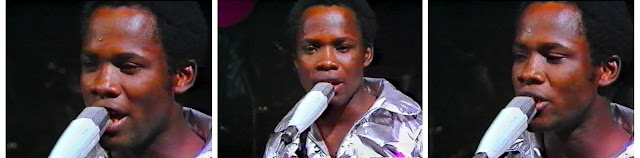
Ndombe 1975My guess is that it did not take a lot of persuading to get Ndombe to join the Tout Puissant O.K. Jazz in 1975. He fitted perfectly into Franco's strategy to merge the styles of the two schools of Congolese music into one.
Again he served as a replacement for Sam Mangwana, although I assume that Franco saw the 'added value' which Ndombe could bring, and which he very soon demonstrated in songs like "Yo Seli-Ja" (video) and - especially - "Salima" (highly recommended video).

Besides being a great addition as a vocalist Ndombe also proved his relevance as a composer. Best known in this early stage of his career with the T.P. O.K. Jazz is his song "Voyage Na Bandundu". Although others see this song as a continuation of his repertoire with Tabu Ley, I don't agree. My impression is that Ndombe tried to emulate the success of Lutumba Simaro's classic "Ebale Ya Zaïre", which had been so brilliantly interpreted by his 'predecessor' Sam Mangwana.

In later years Ndombe produced many hits with the T.P. O.K. Jazz, the biggest of which were the 1982 "Mawe" and "Na Yebi Ndenge Bokolela Ngai" (video) from 1983 (also known as "Masha Masha" or "Mashata"). And perhaps I should add this song, originally from 1979:


Ndombe Opetum with his son (Delft, 1991-08-03)
Ndombe and son (Delft 1991)
In 1983 Ndombe left the T.P. O.K. Jazz*, for reasons which so far I have not been able to uncover. Perhaps they had to do with Franco's lengthy stay in Europe, and with Ndombe's ownership of a bar dancing, called "Lal Abiy Santamaria", which was his pride until it was burned down (in 1994?).
He teamed up with Sam Mangwana and Empompo Loway in a group ambitiously called "Tiers Monde Cooperation" ("third world cooperation"). The Tiers Monde 'project' delivered - as far as I am aware - three lp's, and four if you count the lp featuring "Fatimata" which is credited to Sam Mangwana (who is only on one of the Tiers Monde Cooperation lp's) and orchestre Tiers-Monde.

Ndombe returned to the O.K. Jazz flock in 1986, and joined Franco on the tour of Kenya that year, and during the concerts in Brussels in April 1987. But later the same year he had another row with Franco and left the band to rejoin Tabu Ley's Afrisa International.
Fortunately Franco and Ndombe put aside their differences and reconciled before Franco's death on October 12, 1989. Ndombe rejoined the T.P. O.K. Jazz and became one of the leading forces of the band after Franco's demise. In 1993, when the band was forced to abandon the name of T.P. O.K. Jazz as a result of dispute with Franco's family, Ndombe was one of the initiators of the new orchestra Bana O.K.. He played a crucial role in the continuation of Franco's legacy until his untimely death.

Ndombe leaves a wife and 9 children.
May he rest in peace.

Ndombe with African Fiesta National and Afrizam
Ndombe with T.P. O.K. Jazz

photo: Aboubacar Siddikh [copyright]
Madilu System, Ndombe Opetum, Lola Djangi Chécain, Aimé Kiwakana (Delft 1991)  

* according to some sources. Other sources claim that he never left the T.P. O.K. Jazz, but was allowed to 'moonlight' with Tiers Monde.

May 13, 2012

Bronkoni

Two of the tracks I am sharing with you in this post were on a cassette labelled "Super Biton National 81" which I bought some ten or eleven years ago in Bamako.
It was only last year that I found out I had been misled.

In meeting the musicians from Super Biton in Bamako, last October, I asked them to help me out with the titles of a couple of cassettes attributed to them which I had collected of the last thirty years. Much to my surprise they identified these two tracks, which up to then had been among my favourite "Biton" tracks, as being performed not by Super Biton from Segou, but by Orchestre Bronkoni* from Niono!

The name rang a bell. I had heard of this orchestra in 1988 during my visit to the last of the old style Biennales in Bamako. Two years later I even ventured down to Niono, partly to retrieve some music by this mysterious group, and partly because others had pointed the small town of Niono out as a "hotspot" for traditional Bambara and Sarakolé music. Disappointingly I only found a disproportionate amount of Sudanese music (largely due to the presence of a Sudanese medic, I was told), and some Dutch (agricultural) development aid workers.

In the meantime the name "Bronkoni de Niono" appears to be almost exclusively associated with one artist: Adama Yalomba, who seems to have been touring in Europe (and perhaps also other parts of the world). Apparently he has been a member of this orchestra at one - undefined (!) - point. As seems to be common on the web, all references are indiscriminately copied (and often even without bothering to change the wording).
I am told he is not the only musician with a history with Bronkoni. But I am sure Vieux Paré (video!) is not as well known in the west, so you won't find as many references linking him to the Niono orchestra.

Getting back to the music, even now I have a hard time not associating this music with the legendary Super Biton orchestra. These two songs are of such a high standard, and so brilliantly executed, that it seems hard to imagine them as originating from another source. The opening lines are 100% in the Biton style, with a superb horn section sliding in over the guitar intro. A spine-tingling opening usually only to be found with the music of Biton.
On the other hand it can be seen as an indication of the general - exceptionally high - level of the Malian orchestras, during their 'Golden Years' in the 1970s and 1980s.

Both songs feature elements which can also be found with other Malian orchestras, such as the female impersonation (in "Pary-Mary") and the 'underground' organ (in "Kômon Foli").
But I for one certainly would love to hear more from and by this great orchestra.

Two songs by Bronkoni de Niono

As a foretaste of things to come, I am adding a track which I recorded myself at the Biennale in 1988. The track is by the orchestra representing the district of Bamako: Bamansaba de Bamako. The photo on the right taken during this concert should give you an idea of the circumstances during this concert on September 11, 1988 at the Cinema Rex in the center of Bamako (which no longer exists).
In a future post I hope to write more about the competition of the "Orchestres Modernes" of the 1988 Biennale.

Bamasaba de Bamako - "Danaya Kouma"

* Toussaint Siané wrote "M'Brokoni", and Florent Mazzoleni "Boronkoni", but it's all the same orchestra...

April 30, 2012

Soy

I have been very busy with other matters, but wouldn't like to finish the month without at least a small post. There is plenty more to come, and I hope to have more time in the coming month.

Anyway, here is a single originally recorded for Franco's Boma Bango label. But it's not by the O.K. Jazz, but by the Negro Succes, the orchestra which Vicky Longomba had started in 1959 before joining Kabasele at the Table Ronde in Brussels.

I particularly like the A-side "Yo Se Que Soy", as superb bolero which I am sure Franco would have loved. It's probably a cover of a latin song, and I have tried very hard to find out by whom. Going by the dramatic lyrics and the words used, I would guess the original is Cuban. But so far I have not been able to trace the source.
Perhaps you have an idea. If so, please let us know.

Side two is rumba, composed by Franco's brother Bavon Marie-Marie, and very much in the Negro Succes style, which the typical maracas shaking in the background.

For more singles I refer you to the great Dial Africa blog which is sharing some great Congolese singles (and please do go on!). But in the future I will be posting some more singles as well.

 African 90.202

March 26, 2012

A.T.T.

To tell you the truth, I have been totally and utterly flabbergasted by the 'coup d'état' which took place in Mali last week. Or perhaps I should use the word "dumbfounded", - if only for the inclusion of the word that immediately springs to mind: "dumb". For how stupid can you get if you think that overthrowing the government of a respected and liked president like Amadou Toumani Touré is going to solve anything, let alone the trouble Mali is having with rebel groups in the v-a-s-t northern regions of the country?
A.T.T., 1991

The effect is as predictable as it is sad. Mali's reputation as a democratic and stable country, which was carefully built up over the last twenty years, is shot. The reaction to the coup has been resolutely negative, both from African countries and from influential countries like the former colonial power France. Inside the country Malian citizens are in dread of the present (with disorderly troops roaming the streets of the capital), and in fear of the future, with the food situation already getting perilous (prices are doubling from one day to another).

What can possibly have inspired this captain Amadou Sanogo to execute this coup? Does he seriously think that a coup is going to make an end to the "incompetence" he accuses A.T.T.'s government of in handling the Tuareg crisis in the north?
Personally I am inclined to think that if ever Mali had a government capable of resolving this long-time dispute it would have the very government that has been overthrown. Please get me right: I don't mean to say that I know all the ins and outs of the political scene in Mali. I am in all respects an outsider, looking in from the outside, - but still looking in....

The fact that A.T.T. also led a coup d'état, exactly 21 years ago today (i.e. on March 26, 1991), can not be used as an excuse for this coup. Even the fact that the Tuareg rising played a (marginal) part in the 1991 coup can not be used as a justification. The coup in 1991 came after a long period of protests against an autocratic government that had done its utmost to resist any form of democracy, and that had long lost the support of the population. A.T.T. can not be compared to Moussa Traoré.

For further reading about Amadou Toumani Touré I advise you to read the paragraph on him in the Wikipedia.

For now, I would like to share with you a cassette from 1991 (the year in which A.T.T. overtrew Moussa Traoré), bought in Mopti (the town where A.T.T. was born), and recorded by one of my favourites "vendeurs de cassettes" in the local market: Amadou Fofana (more of his cassettes in future posts). The subject of the cassette is A.T.T. himself. And I have no doubt the song is in praise of the man.
About the artist(s) I know absolutely nothing, apart from the fact that they sing in Peul.

Ganari 1991

And to cool myself down, after getting very worked up, I am adding this short relaxing video from the days when peace still reigned in Bamako.....

March 22, 2012

Limelight

Please don't think that the stream has dried up. I have been very busy digitising more cassettes and records. Given the small amount of time I have this has kept me from sharing more musical wonders with you in the last fortnight.

In this post I would like to revisit the music of one of my favourite orchestras: Franco's O.K. Jazz. And in particular I would like to share more examples of the musical talent of Lola Djangi a.k.a. Chécain (see this post, and many others).

In my earlier posts I wrote about his role as a vocal "deuxième". This usually means the lower of the voices in a song. In this position out of the limelight Chécain's voice can at times - by those unfortunate beings who are less acquainted with the work of the O.K. Jazz - be mistaken for the voice of another vocalist. I can particularly understand his voice being confused with Franco's. Those who have heard his interpretation of "Mario", after Franco's death, will have to agree that - apart from the power which came from Franco's assertive personality - it was the closest anyone has come to Franco's original in sound and timbre.

But luckily Chécain has found another way to 'make his mark'. In the majority of his songs he manages to insert some kind of spoken comment. In the first of these six songs I am sharing with you in this post. "Ta Noel", he can be heard after 33 seconds, - exactly the same moment as his intervention on the B-side "Bana bakufelaka ngai tina nini?".

Both these songs, sung by Youlou Mabiala and Chécain, were composed by sax player Isaac Musekiwa, not one of the regulars when it came to contributing compositions. One would perhaps expect a good dose of sax, but in fact the horns don't show up till after 1'52 and - although present - don't outshine Franco's guitar. On the B-side we even have to wait for just more than two minutes to get any sax....

According to the label of this single on the African label, but originally released on Franco's Epanza Makita, the single was produced in 1970. Although dating in this period is a tricky business I think this must be correct, given that Chécain's "Emilie Na Gabon" and Youlou's "Likweyi" (both on Sonodisc CD 36520) were released as Epanza Makita 100 and 101. Of the singles released on the Epanza Makita label relatively many remain undigitised. And the singles of this period that háve been digitised have sometimes been sadly mistreated.

African 90.464 [Epanza Makita 114]


The second single was released on Decca's Congo sublabel. The B-side of the single is the same as the B-side of the first single. The A-side was originally released as Epanza Makita 111, with "Nabanza tele" on the flipside (according to Ewens). This song, "Nganda Benda Bika", was composed by Michel Boyibanda, who is also one of the three singers. The others are, yes you guessed right, Youlou and Chécain.

In this song Chécain is perhaps a bit harder to discover. He is certainly not responsible for the spoken incursion after 52 seconds. To be honest I don't really know who is talking there. Any ideas?

The quality - 'vinylwise' - of this single is disappointing, as is the case with most of the singles I have heard of this label. I am not sure if this is a problem of aging or one of intention on the part of Decca.
Musically this is also not one of the hottest songs in the extensive catalogue of the O.K. Jazz....

Decca Congo CD.191 [Epanza Makita 111/114]


In case you are wondering: the A-side of the next release on the Epanza Makita label, Epanza Makita 112 was "Bolingo Marie-Angele", composed by (who else?) Chécain, and digitally released on Sonodisc CD 36514. This is a track very much in the vein of "Ta Noel"/"Bana bakufelaka ngai tina nini?", - with Chécain's trademark comment at almost exactly the same point in the song.

Our friend again features in the next single, released originally as Epanza Makita 113, but here in the Decca Congo version. On both sides he is backing Michel Boyibanda, and this appears to give him almost an equal spot in the vocal balance. Particularly in these two songs the resemblance to Franco is noticeable.

Listening to the opening of "Simon Temoin Ya Libala" (I suppose this means "Simon witness at the wedding") one wonders what Chécain contribution was in this composition by drummer/conga player Jean-Félix Pouéla a.k.a. Du Pool (who I think I mentioned earlier*), as the bride appears to be his dearest Emilie ("Emilie mon amour"). The same Emilie as the one in Gabon (see above)? Chécain certainly has composed songs about his own experiences.

In both songs he is a bit late with his chat. He doesn't show up until after 0'50. I must add that someone else takes over after him (after 0'56) in "Simon Temoin Ya Libala".

I like these two songs, despite the poor record quality. Although they don't radiate brilliance on the level of Franco's Great Hits, they are good enough for a modest spot in the limelight.

Decca Congo CD.192 [Epanza Makita 113]

All three singles can also be found, bundled together, here.

* and who I as I recently noted also played on that classic Papa Noel album "Bon Samaritain", with that glorious voice of Carlyto.

March 08, 2012

R.T.M.

I have been rummaging through my archives again and dug up some cassettes by Malian female singers. Singers who are perhaps relatively unknown in the western world. And there is a good reason for this, as Kandia Kouyaté (see earlier post, post and post) once explained to me.

One reason is that the music of these singers is uniquely directed at the local market. They sing at ceremonies like weddings and baptisms, at soirées (or 'sumu') and such. The scale of these events is usually such that most participants or persons attending are known to the singer, or people assisting the singer.

And that brings me to another, no - to the number one reason. This is, of course, an economic one. By praising, or at least singing about, respected, respectable and/or self-respecting members of the community the singer can make a good living. And in some cases even an excellent living. Anything from money, handbags, jewelry, items of clothing (pagnes but also silk, embroidered dresses etcetera) to cars and villas can be bestowed on a talented artist. The extent of gratitude on the part of the receiver of the praise is largely dependent of his or her social prestige, or at least the perceived social prestige.

And that is a key ingredient of Malian society: prestige. I have been to events where Malians friends did not dare show up, as they were - rightly - afraid that they would be the subject of griot flattery. As they were (temporarily) financially incapable to live up to their social status, they preferred to stay away. On the other hand I have seen poor Malians give away their family fortune when they fell into the hands of a griot who managed to hit the right button....

So that is why for most female griots there is no reason to gather fame abroad. Ironically the location of this talk with Kandia Kouyaté was Amsterdam......
But that is the subject of a future post.

This post is about one of the more succesful griots: Naini Diabaté. When I first travelled through Mali in the 1980s, there were plenty of stories going around about this singer, who was born in Bamako in 1963. One of the more spectacular ones was that Naini, being blind in one eye, during a heated performance had miscalculated the extent of the stage and had fallen into the crowd. Others claim that she was the first female griot to perform on Malian television in 1983, at the newly constructed (and Libyan funded) broadcasting centre of the R.T.M.. I have my doubts about this claim, but it is reasonably certain that Naini Diabaté rose to fame as a result of her television performances.

Seeing this video from a performance in (probably) 1988 will give you an idea why.


Naini in turn repaid the R.T.M. by singing its praise. And, if you ask me, this praise is well deserved. For the Radiodiffusion Télévision du Mali, which was renamed "Office de Radiodiffusion Télévision du Mali (ORTM)" in 1992, has served Mali - and in particular Malian culture - well. Not just by the many televised performances by Malian artists, but also by the wide range of audio recordings made at their studios. Many of which - by the way - were subsequently released on record or cassette outside Mali.

This is not the case with the cassette Naini recorded for Beny Mariko's label in 1988. I really like this cassette. And not just for the memories which it evokes for me. Not just in the title song "R.T.M." (yes again), but particularly in songs like "An Sako Be Ke", with its variety in amplitude, and the deeply soulful "Sory", the overwhelming "Diamou Niagale" and the skillful "Diagneko" Naini Diabaté demonstrates her maturity and tremendous power as a singer.

You can find more great videos by Naini Diabaté on Ngoniba's great Youtube channel.

Beny Mariko BM-018, 1988 [new link June 3, 2014]