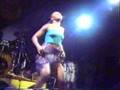
In rummaging through my computer the other day I stumbled upon another video by that great Malian diva Kandia Kouyaté from her very first appearance on Malian television. I have posted two songs from this same concert before (here and here). But watching this I was again bowled over by the sheer power of her presence - at the age of only 18 (!) - and the total command she displays.
Look for yourself:
Note the cheeky look, after 0'48, followed by that heartmelting smile: isn't she just incredible?!
I gather the song is about good deeds (wale gnouma), about gratitude (wale gnoumandon) and about ingratitude (wale gnoumandonbaliya).
It's just that a mere "thank you" seems so insignificant after watching such a brilliant performance....
March 19, 2011

March 16, 2011
Balla n'est plus
Off topic: you may have wondered why I haven't been posting as much as before. There are several reasons for this, but the most important two are my discovery that a lot of my original CD's were beginning to disintegrate and - in the last two weeks, and possibly related - a crash of the system hard disk of the computer I use for blogging and music. Both are fortunately under control, - although there is still a lot of work to be done in backing up CD's. But I am hopeful I can increase the frequency of these posts.
 |
| Balla Onivogui(l) and Pivi Moriba, December 1999 (photo R. Lokin) |
Balla was best known as leader of the wonderful Guinean orhestra from the Syliphone era Balla et ses Balladins. Born in Macenta, he started his career as a musician in Kankan and subsequently was sent to the Dakar conservatoire (musical college) on a scholarship. In 1959 he joined the Syli Orchestre National, where his talent, not just as a trumpet player, but also a leader, caught the eye of the authorities of the young republic. When the Syli orchestre was split up, he was put in charge of one of the sections. This section played at the Jardin de Guinée, a bar dancing, which I am told exists until this day.
 As their reputation grew they took on a more independent name: Balla et ses Balladins.
I am sure you will read more detailed information about this great orchestra and its leader on other sites (for example here).
For now I would like to share with you Balla's first album, with the Orchestre du Jardin de Guinée. This was released as the second album of the Syliphone label, and has for many, many years been one of my top favourites of the label. Every single track on this album is a pearl, shining by the pure joy and love of music of Balla, Pivi and all the individuals of this superb orchestra.
To me, Balla Onivogui has reached a rare state of eternity. Through his music he will live on forever....
Syliphone SLP 2 or here
May his soul rest in peace.
* There are sources stating he was born in 1938. Several Guinean sources claim that he was 75 when he died yesterday.
February 20, 2011
Four mysteries
 I am hoping someone can shed some light on these four mystery tracks.
The mystery is not in who is singing. The singer is clearly and recognisably the great Aboubacar Demba Camara. This limits the options when it comes to the orchestra accompanying the man: it is either the Syli Orchestre National or Bembeya Jazz.
My guess would be the latter, but both is also a possibility (with the first two songs by Syli National and the last two by Bembeya) .
The mystery lies mainly in the origin of these recordings. I have so far been unable to trace when, where and by whom they were made. And the titles are just guesswork, because they were missing on the source cassette (In fact, there was nothing at all on the cassette to indicate its content).
By the inclusion of the two Cuban (or at least latin) songs I am inclined to date these recordings shortly after Demba's trip to Cuba. He went there, as he told in an interview with the R.T.G., in December 1965 and met Cuban legend Abelardo Barroso. This must have inspired him to do some more Cuban songs....
So please feel free to speculate. And if you have some expert knowledge, please step forward!
4 songs from the sixties
EDIT February 21, 2011: Although all four tracks are from the same cassette, the last two appear to be a bit fast. I am adding two attempts at correcting this. Please let me know which one you think is correct.
The corrections are all in this file (new link May 28, 2011).
February 19, 2011
Classic
 It was Ntesa Dalienst who made us aware of the fact that Franco was playing in the opening track of this classic album by the Tout Puissant O.K. Jazz. Until then we had assumed that he was not involved; an assumption that seemed to be confirmed by the absence of a composition by the Grand Maître himself. Contributing to this assumption was the growing awareness that many of the guitar bits which are generally labelled as "Franco's guitar" are in fact Thierry Mantuika playing like Franco.
In fact, Franco is playing right from the start, and brilliantly too.
In the first song his guitar is on the right, and in the three other songs it is on the left. I have to add that he does not play until after 2'46 in "Nda-Ya".
Many critics consider this lp, which was released in 1984, to be one of the best of the T.P. O.K. Jazz. And I think there are many reasons to support this. For one, the top three vocal heavy-weights of the 1980s O.K. Jazz are present in all the songs: Josky Kiambukuta, Ntesa Dalienst and Madilu System. Secondly, there is no weaker song in this album. And there is certainly variety in the styles of the four songs.
The opening track is a composition by Josky. The title "K.S.K." is an abbreviation of ""Kasongo Sefou Kitima", which is the name of a person. As Josky explained in 1991*, he composed the song during a visit to Kenya in 1983. In that year, after playing in Brussels in May (see my earlier post), the orchestra went to the US for a short visit. On their return to Brussels they were invited to perform in Kenya. They spent one month in Nairobi before returning to Belgium, where the album "A L'Ancienne Belgique" (referring to a concert-hall in Brussels) was recorded at the Studio Madeleine.
 Unlike the majority of Josky's compositions "K.S.K." is not a song about love. It is - as he put it - a song about life: you work well, you're a nice person, you help people, you help your friends, but still there are people who are against you.
"Nda-Ya", composed by bass player Mpudi Decca, is also a name, but of a woman. As Ntesa explained, the song is about a man who is in love with a woman, but his mother has told that he should marry Nda-Ya. When the marriage with Nda-Ya does not work out the man blames his mother.
The lyrics are in Decca's dialect of Kikongo, Kitandu, - which is remarkable as Ntesa was born in a family speaking another Kikongo dialect, called Kisingombe.
The B-side opens with what is perhaps Madilu's most famous composition with the O.K. Jazz, "Pesa Position Na Yo" (which is - I am afraid - not saying much, as he composed only two songs with the orchestra...). Madilu performed this song at nearly all the concerts in the following years, but usually with other singers backing him. In this video from 1986, for example, by Kiesse Diambu, Aimé Kiwakana and a very young Malage de Lugendo. Personally I prefer this original version, with the solid backing by Josky and Ntesa, and the understated and subtle guitar playing of Franco.
Fittingly, in the last track, "Mukungu" composed by lead guitarist Gerry Dialungana, none of the three singers has a lead role (although in the O.K. Jazz terms Ntesa - as the one with the highest voice - sings the first vocal). Instead the instrumentalists dominate this song. And, of course, this means that Franco is allowed to 'do his thing'. He does so brilliantly, gradually pulling out all the stops after about 7 minutes, with some inimitable shuffles.
In case you are still wondering which guitar is Franco's: he is on the left (I recommend using headphones).
Edipop POP 031 or (MF) here
Edipop POP 031 (flac)
*You can hear Josky's comments in Aboubacar Siddikh's posting on YouTube of this album.
January 17, 2011
Panoramic interlude

 I suppose this is not the most spectacular compilation of Senegalese music imaginable, but in the 1980s it did fill a gap in my appetite for more, after getting into contact with the likes of Number One and the early Etoile records.
 Omar Pene's vocals in "Bass" still manage to pierce through concrete walls, as they did when I first heard this decades ago. And Baobab's "Utru Horas", titled "Loi Di Nos" in this collection, is still cool enough to elicit a kiss from my wife. I prefer the version of "Sutukum" by Canari de Kaolack on Touba Auto K7 because of the exaggerate stereo. On this album it seems to have been 'corrected', - which is a pity...
But, as I said, it is an interlude.
Bellot MCA 306 (new link July 25, 2014)
January 15, 2011
Tribute
 Preparing this post has been quite an emotional experience. And not only for the passionate music, but also for the memories of a trio of friends that have now gone. With the death of Zani Diabaté none of the men, who met at the Ballet National du Mali and who subsequently decided to 'do their own thing' on the side by starting the now legendary Super Djata Band, remains alive. Alou Fané, singer and dancer, master of the kamalen n'goni, proud member of a blacksmith family and a unique personality, was the first to go, over fifteen years ago now. A loss felt to this day. A few years ago saw the death of Daouda 'Flani' Sangaré, musical researcher, extraordinary singer, terrific dancer, sought-after romantic (very popular with the ladies), but also a man who had experienced the deepest depths of misery - after losing his parents at a young age and then (in the last decade) his second and finally his first wife -, and a warm and caring friend. And now Zani, the first and last with the Ballet, who besides a spectacular and unique guitarist was a dancer, multi-instrumentalist (with a background in djembe and other percussion instruments), bandleader and organiser, driving force, as well as being a (in my opinion: too) modest and very friendly guy.
I would like to use the music of Zani and his friends of the Djata Band as an illustration in this tribute. A few of these tracks I have posted before, but most you will find nowhere else. Those recordings were made in a private ambience, at concerts or even by Zani himself.
1. Noumouna Kouloumba
A track from the early 1980's and recorded at the Radio Mali studios in Bamako. This is in fact a medley of donso n'goni songs, made popular by the great Toumani Koné. It starts off with Zani frantically setting the pace in a tune known as "Dangoroba". Flani is singing the lead, with Sidi* Touré backing him.
 After 1'24 the band seamlessly moves into what is probably "Gon Magni" (see 5), followed after 2'40 by "Noumouna Kouloumba". Note how Zani uses the guitar to imitate the shooting of a rifle (e.g. at 1'45). After 4'22 wanders off with a solo that illustrates his fantastic rhythmic skills, as he meanders around the main rhythm but always gets back on the right spot. The medley ends with a version of "Baba", a track covered many times by other artists (in various forms).
2. Sinaya
A favourite among the Djata Band songs, with (I suspect) the same Sidi Touré singing alongside Alou Fané; I don't know who the third singer is (who starts after 3'10). I can picture the whole orchestra dancing on this very delicate rhythm, with the unique and unforgettably subtle moves of Alou (a bear of a guy, but what refinement in his dancing...). Very vaguely in the background in the instrumental bits you can hear a sax. I suspect they deliberately didn't open the volume of his microphone, - and that was in my opinion a wise decision by the technicians at Radio Mali. Zani's solo (from 1'43) accentuates the turning and twisting of the dancers. The use of some 'wa wa' effects (2'30) reflects Zani's admiration of Jimi Hendrix (he was near ecstatic when Aboubacar Siddikh gave him a pile of Hendrix cassettes in 1999). I love the part from 4'53 where Zani adds some coal to the fire; I wonder if he could resist doing acrobatics on the studio floor while playing this...
3. Yacouba
Recorded during a concert in the Melkweg, Amsterdam on March 20, 1987, by Joris Oldewelt. This same concert was recorded for release on lp (Milady Music 10023, also released on cd). I refer you to my earlier post for an explanation of this song (and a video). I love Zani's dynamics in this version, with some lovely restrained, almost tiptoeing guitar. Flani's singing is really superb in this song, full of genuine emotion when citing the names of the greats that have passed away...
4. Taasi Doni
A recording of a session at my place, almost exactly twelve years after the previous song, of a song made famous by Super Biton from Segou. Flani was a good friend of Biton singer Mamadou 'Percey' Doumbia. This song was never part of the Djata Band repertoire, so you can hear Zani switching to more suitable chords, displaying a great talent for improvisation. Zani and Flani were in Holland to perform in the 'Opera Bambara' with the title "Fura". I'll post more songs from this session at a later date.
5. Gon Magnin
Recorded by Zani himself during a concert in a village on the outskirts of Bamako. Another classic from the repertoire of Toumani Koné, brilliantly interpreted by Flani and Zani. After 2'30 launches into a solo in which he pulls out all the stops. This song has such pace, that lift-off is almost achieved....
6. Signana
From the same lp as #2 (and yes, I did post this one before) and clearly recorded during the same session, with the same suppressed sax. The two songs may seem very similar at first, but there are a lot of differences. For one, Flani is singing with Alou replying, together with Sidi Touré. This is a song from Flani's roots in the Ganadougou district near Sikasso. My impression is that this was originally a balafon song. Because the monotony of the rhythm the impact of Zani's solo from 2'55 is all the more intense. Again he shows his love for Hendrix's music, but he does so in an amazingly functional way, because it just increases the effect on the dancing and twirling, - which I know must have gone on when this was recorded. After 4'58 the sax player actually discovers that his microphone has not been switched on, and is allowed some 30 seconds of audible contribution. This is certainly one of my top favourite Djata songs.

7. Diabaté Zani
After the two video versions I posted (here and here) here is a third version of this song dedicated to Zani himself. This is from the same concert and recorded by the same person as #3. Attentive listeners may have noticed that this is in fact the same song as "Bomama" by Super Biton. In his solo, after 3'08, Zani does a series of acrobatics, rolling on the floor and sliding his guitar underneath his body. Alou's singing after the solo, however, is somewhat below par. This song does give a good impression of the reception the band got from Dutch audiences.
8. Koursigui Tan
 From the same session as #4. The recording begins by me trying to explain which song I was refering to in a discussion that took place earlier. The original, of which I play a few seconds, was by Flani and Alou and their kamalen n'goni act. Zani needs a few moments to recall the song and Flani helps him by singing a few lines from the song. After a while Zani decides it is better to keep the guitar playing monotonous to imitate Alou's n'goni of the original. This certainly gives the song more pace, and goes on 'till the break at 4'25. The subsequent variations again show Zani's skills as an improviser.
9. Fadigna Kouma
This is a song from the very first recording of the band in the Netherlands, on December 18, 1985, at the Melkweg in Amsterdam. It was recorded by VPRO Radio, under the guidance of the late Dave van Dijk. The track starts off with the balafon of Bakari Diabaté, Zani's younger brother, who died some years later. Again perhaps not the best version, but a good illustration of how difficult it is for western engineers to get the sound right. They have a strong tendency to 'normalise' all the instruments and singers within a group, i.e. to record all at roughly the same volume. This tendency has had some dramatic results over the years, the most remarkable being the mixing out of Franco's guitar in the recordings of the 1986 concert in Utrecht (this was 'rectified' in the re-release of the lp). And while we're on the subject: besides being a fan of Jimi Hendrix Zani was - like so many African guitarists - perhaps an even bigger fan of le Grand Maître. Franco's influence is apparent not by Zani playing Franco-like chords, but rather by the boldness of his guitar playing, the choice for an own original sound and - on the level of the guitar playing itself - the awareness of the power of repetition.
10. Facia
Recorded at the Van der Valk Hotel in De Bilt (near Utrecht, the Netherlands) a few days before #4 and #8, this is a truely sparkling version of the Djata Band classic "Facia". Flani improvises with the lyrics to sing about their friend Alou Fané, who had passed away five years before. Zani is filling in both the rhythm and the solo. Such a delightful song!
As a comparison, here is the version of the same song performed by the complete Super Djata Band, in their optimal line-up, during a concert in Angoulême, France, in 1984. This was, by the way, the first performance by the band in Europe.
 11. Mali ni woula
 To round off this tribute another song recorded at the Radio Mali studios in Bamako in the early 1980s. With the title meaning "Good evening Mali", this is a version of a Na Hawa Doumbia song. It is sung (solo) by Flani, who was very friendly with Na Hawa and her husband N'gou Bagayoko, and visited them whenever he came to or passed through Bougouni (where Flani's eldest son lives). While Flani attempts to recreate the 'modest' atmosphere of Na Hawa's song, Zani offers a contrast with a spectacular and 'full-scope' solo from 2'47. Towards the end, from 5'30 onwards, Flani cites the names of the band members.
There will be more music by Zani, the Super Djata Band, by Alou and Flani, and by Alou and his group Fotemocoba and by Flani on this blog. These great artists and friends may be gone, but their music will live one......
The 11 songs can also be downloaded as one file here (new link March 7, 2014).
*if I remember his first name correctly...
PS: the photo on the top-right was taken by myself at his home in (I think) 1990.
January 06, 2011
Thumb piano
 One of my resolutions for the new year is to post more traditional music. I am well aware that the distinction between modern and so-called 'traditional' music is at times not as clear as it may seem. A lot of modern music is at the very least inspired by themes, topic and tunes handed over from one generation to another, - or in other words by tradition.
 So to start off the year I would like to share with you this cassette which I bought years and years ago in the early 1980s, - and long before these historic recordings made by Hugh Tracey between 1948 and 1963 were remastered and digitised. Although some, most, or possibly all (sorting this out is complicated by the fact that some of the titles have been changed - see my first attempt here*) of these recordings are probably available on cd, I still feel there is a case for posting this cassette. For I would like to put it to you that the sound of this cassette is in most cases better, or preferable if you like, to that of the cd's. Listen and compare...
The production of this cassette betrayes the pure amateur love for the music by the people at Folktracks (who don't seem in any way related to Folkways), with pre-computer printing and tightly folded, but extensive sleeve notes. From the archives of the International Library of African Music (ILAM) they have compiled 20 songs featuring the mbira, or sanza, or likembe, or thumb piano. The artists in these recordings have been fully credited. And there are some legends among these. Like Zimbabwean mbira legend Simon Mashoko ("Saimoni Mashoko" in the notes - photo on left). For others these recordings are possibly the only ones that were ever made of them.
I particularly like the tracks by Ngaina Lolo (A2 - love the resonance), the one by Simon Sitale (A8 - the mbira like a blanket for cold ears), the storybook-like "Kemai" by Kayoka Ladislas & Beya Marcel (A10), the very Zimbabwean sounding track by Baranganani Mudzanani from South Africa (B3) and the soulful song for the chief by Chabarwa Musanda Mayo Sinyoro** (B4).
Folktracks AFR-45-802 (new link May 3, 2012)
* And please feel free to suggest additions.
** one person or two?
January 02, 2011
Sudan
 At the beginning of this new year I would like to wish you all the very best!
I am starting this year with some music from a country which has so far remained unmentioned in this blog. There is a very good reason for this: I know next to nothing about it, can't read and don't understand a word of arabic, and a generally a total stranger to the - no doubt - wide range of cultures in this vast country. I have never been to Sudan, and the cassette I would like to share with you was not bought in Sudan. Well, at least not in the country we now call "Sudan". The cassette (on the right) does carry an indication of where it was bought: "BMDA" stands for "Bureau Malien du Droit d'Auteur". So the cassette was bought in the early 1990s in the former French Sudan. In fact, there were quite a few cassettes of Sudanese music available in Mali, and I may post another later.
You can read more about the artists featured on this cassette, Al Balabil, on the GhostCapital blog, although I hasten to add that the information is limited, and I get very itchy when African artists are labelled as African versions of western stars (in this case "The Supremes of Sudan" - aaaaarghh!).
cassette 1169 (or here) (new links January 22, 2012)
I have no video of this female vocal trio, but I do have some videos of other Sudanese artists. One of my favourites is this one, by Kamal Tarbas, of whom many videos can be found on YouTube.
I just love the relaxed 'ambiance' of this video, recorded (sometime in the 1980s) on the banks of the Blue (or White?) Nile. And the music is simply wonderful.
December 29, 2010
Torch
 I am finally getting 'round to posting this album. The reason for the delay is not in the lp itself, but in the video that goes with it. I have struggling to get the sound at least acceptable. Although I don't think I have succeeded I doubt I can do more to get it right. Besides, the exceptional quality of the sound of the lp should help to balance matters....
The lp is by the Super Boiro Band, and was released on the Syliphone label in Guinea, which in any case is a guarantee for a superior quality of music - and sound. The name "Boiro" was rapidly changed after the death of Sékou Touré and the fall of the Syli regime, as it carried associations to the infamous prison camp, Camp Boiro, in which a staggering estimate of fifty thousand (mainly political) prisoners were said to have died. The Super Boiro Band changed its name into Super Flambeau (flambeau = torch).
And in my opinion this is a far more suitable name given the both fiery and glowing nature of their music, - as is demonstrated especially by this record.
Justin Morel Junior mentions in his sleeve notes that the musicians of the orchestra 'pulled their act together' after visiting the "Semaine National de solfégétisation" in Conakry in 1974. My (rather aged) dictionary has no entry for "solfégétisation", but "solfège" has something to do with singing techniques, so I assume they did some vocal training. This certainly did no harm to their vocal harmonies, which are great on this lp.
But nevertheless I am more impressed by their instrumental skills. Particularly the organ on this lp is on a level of its own. Starting at 5'15 in the first track "Somono" the organist is the true master of these recordings. Highlights of his performance are the - in my opinion epic - version of "Nanibaly", in which I can picture him swaying behind his instrument, before making his dramatically restrained entrance after 3'14. The classic "Samba" is an instrumental tribute to the instrumental talents of the whole Boiro Band, again dominated by the organ.
But there is more to this record. There are 'cool' tunes, like the supercool "Gumbe". There is joy in "Sakonke" ("cuisinées à plus que 100°C"), encouragement in "Khamulan Na", and of course the usual flattery (albeit somewhat obligatory sounding!) of the P.D.G. in "Barika".
Judging by the few tracks I have heard of their work of the post-Syli era, I get the impression that the Super Flambeau managed to retain the high level they show on this wonderful album on the ever great Syliphone label. I for one would certainly like more of this.....
Syliphone SLP 58
As a bonus, and with my sincerest apologies for the crappy sound, here is a video of the song "Sakonke":
December 21, 2010
N'Dardisc
 Graeme Counsel informs me that he has finished the first draft of yet another discography. In this case of the N'Dardisc label.
 When it comes to Senegalese music this is certainly one of my favourite labels, as you may have noticed from past posts (33-11, 33-12, 33-14, 45-18).
This seems a good occasion to add one more. "Folklore du Sénégal - Musique et chants traditionnels" (N'Dardisc 33-10, as you can check in the discography) is normally a title to put any prospective buyer off, - but this will prove to be a serious mistake with the N'Dardisc label.
Side A contains three classic tracks by Soundioulou Sissoko and his wife Mahawa Kouyaté. According to some (notably a presenter from the RTG from Guinea) they are the source of many songs which became hits with the Great Orchestras from the golden age of Guinean and Malian (Malinké) music. Although I have my doubts about this claim, I am sure they have had a substantial influence. On this lp Mahawa, accompanied by Soundioulou on cora, sings "Bandia" (interpreted by both Orchestre de la Pailotte and Orchestre du Jardin de Guinée) and "Sakhodougou" (Jardin/Balladins). Soundioulou adds his interpretation of "Alalake" (e.g. Bembeya), but personally I think he doesn't get close to the overpowering version of Lalo Keba Dramé on N'Dardisc 33-11.
This master of cora and copper vocals (see my earlier post) can be heard on side B, together with Samba Diabaré Samb. And what a deadly duo they are! "Bamba Bodian" is another version than the one on "Hommage A Lalo Keba Dramé", but again by the great master himself. And "Maky Tara" and "Saraba"..... well, I'll leave you to discover these marvels for yourselves. All I will say is that if you liked Samba Diabaré Samb's track on N'Dardisc 33-12, you will be blown away by these.....
N'Dardisc 33-10
Subscribe to:
Posts (Atom)